
“Doctor, I’ve cut out all fat and my cholesterol is still high.” We hear some version of this in our clinic every week. Behind it are a few common mix-ups: that cholesterol is simply fat in the blood, that eggs and prawns are what push it up, and that every kind of fat is bad. None of these is quite right. Here’s what cholesterol and fat actually are, why they travel together, and which fats in your food really raise your LDL cholesterol.
Cholesterol is a building block, not fat
Cholesterol is a waxy substance with a ring-shaped structure. Chemists call this kind of molecule a sterol. It isn’t a fat, and it gives you no energy: your body can’t burn it as fuel.
Instead, cholesterol is a building material. Your body uses it to make:
- Cell membranes: the thin skin that wraps around every cell in your body.
- Some hormones: including oestrogen, testosterone and cortisol.
- Bile acids: which help you digest the food you eat.
- Vitamin D: made from a close cousin of cholesterol in your skin when sunlight reaches it.
Because it’s so essential, your body doesn’t wait for it to arrive in food. Your liver and other cells make most of the cholesterol you need.
Fat is fuel
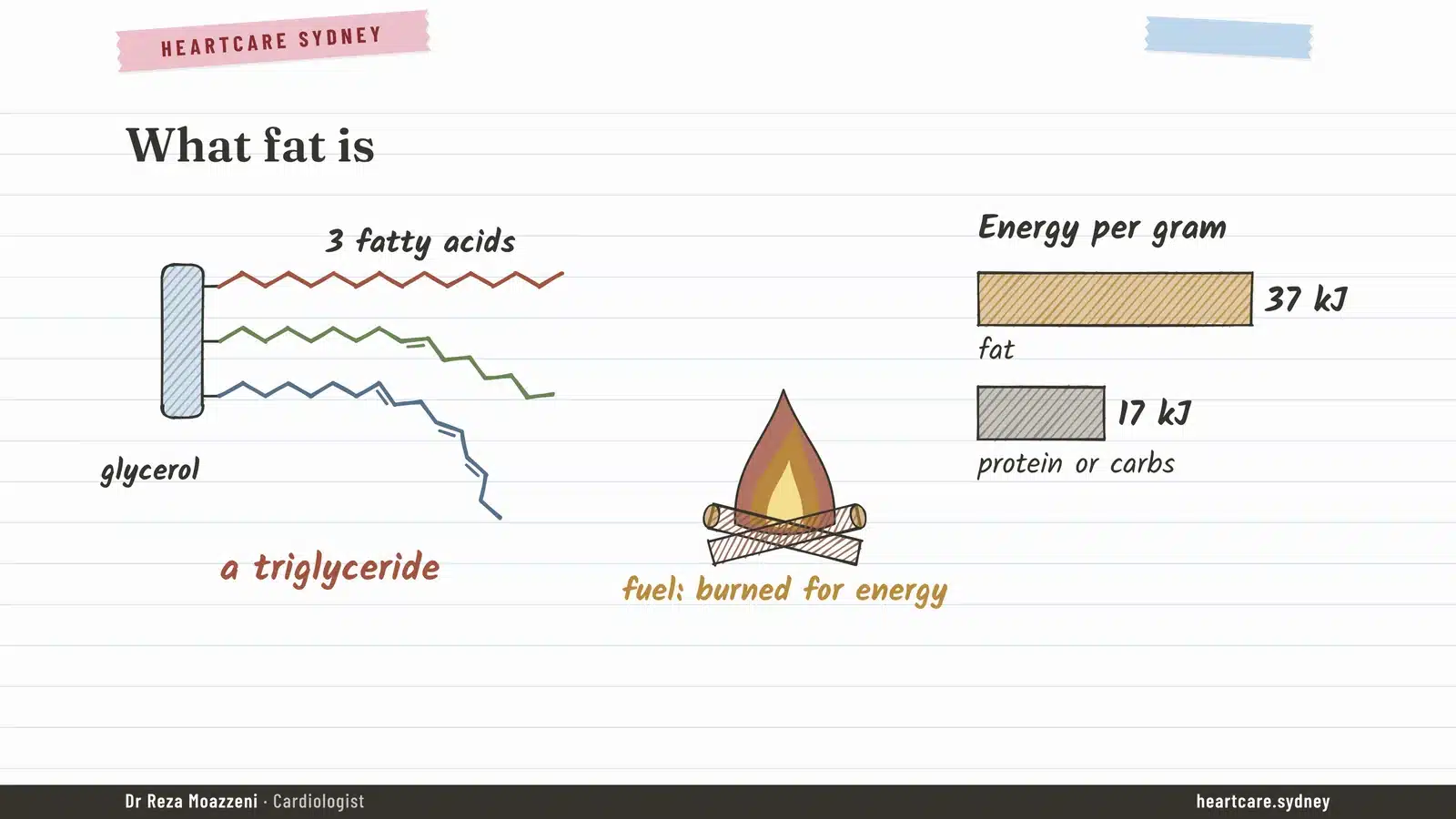
The fat in food, and the fat stored in your body, is mostly a molecule called a triglyceride. Each one has a small backbone, called glycerol, with three long chains attached. Those chains are fatty acids.
The main job of fat is fuel. Your body burns those chains for energy, and fat is a rich fuel: a gram of fat holds about 37 kilojoules, more than twice the 17 kilojoules in a gram of protein or carbohydrate.
Both belong to the lipid family
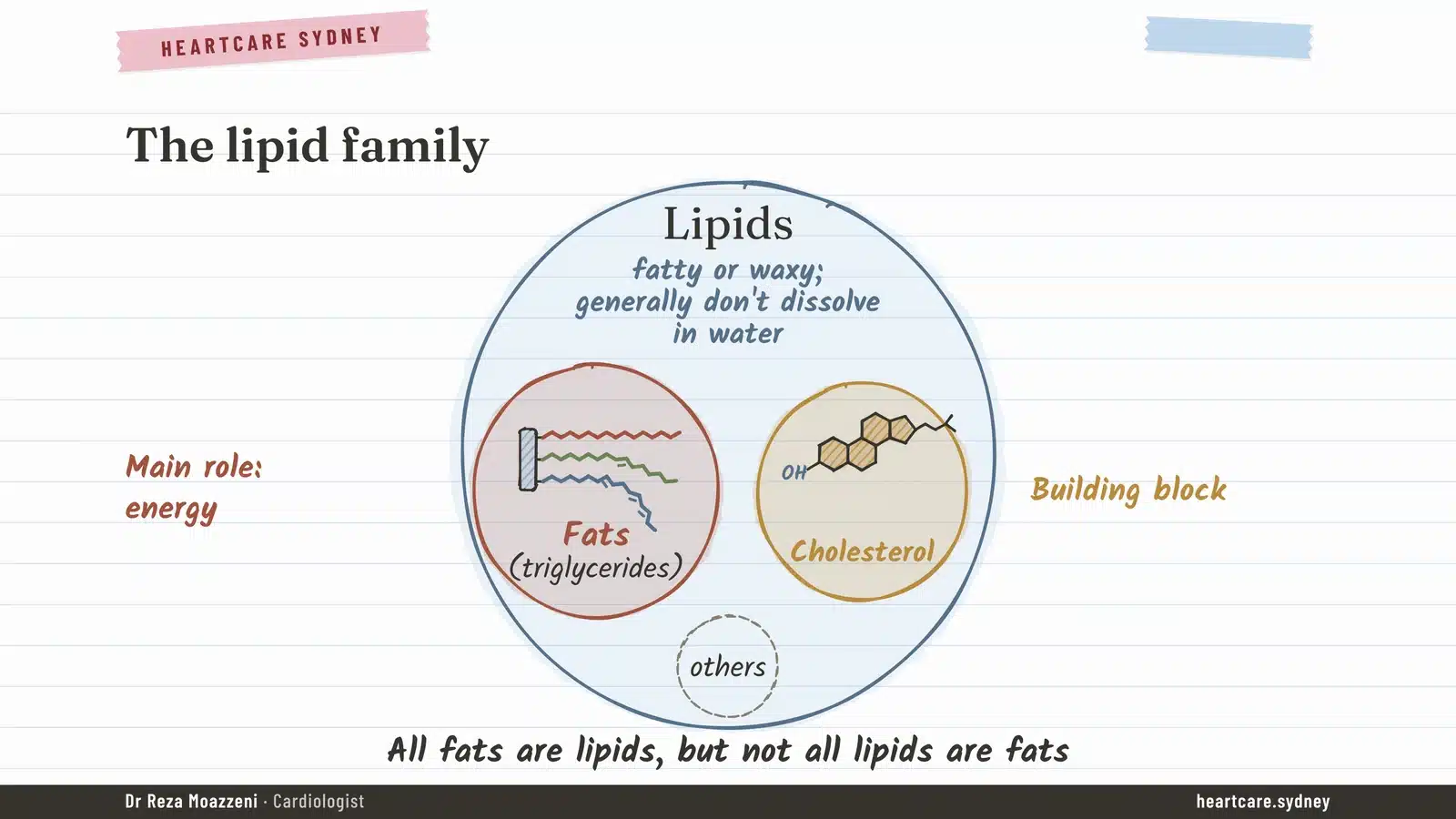
So why are the two so often confused? Both belong to a bigger family of substances called lipids: fatty or waxy molecules that generally don’t dissolve in water. Fats (triglycerides) are one kind of lipid. Cholesterol is another. There are others too, such as the phospholipids that make up cell membranes.
All fats are lipids, but not all lipids are fats. Cholesterol is a lipid, but it isn’t a fat: it’s built from rings, and it’s a building block, not fuel.
Why fat and cholesterol travel together
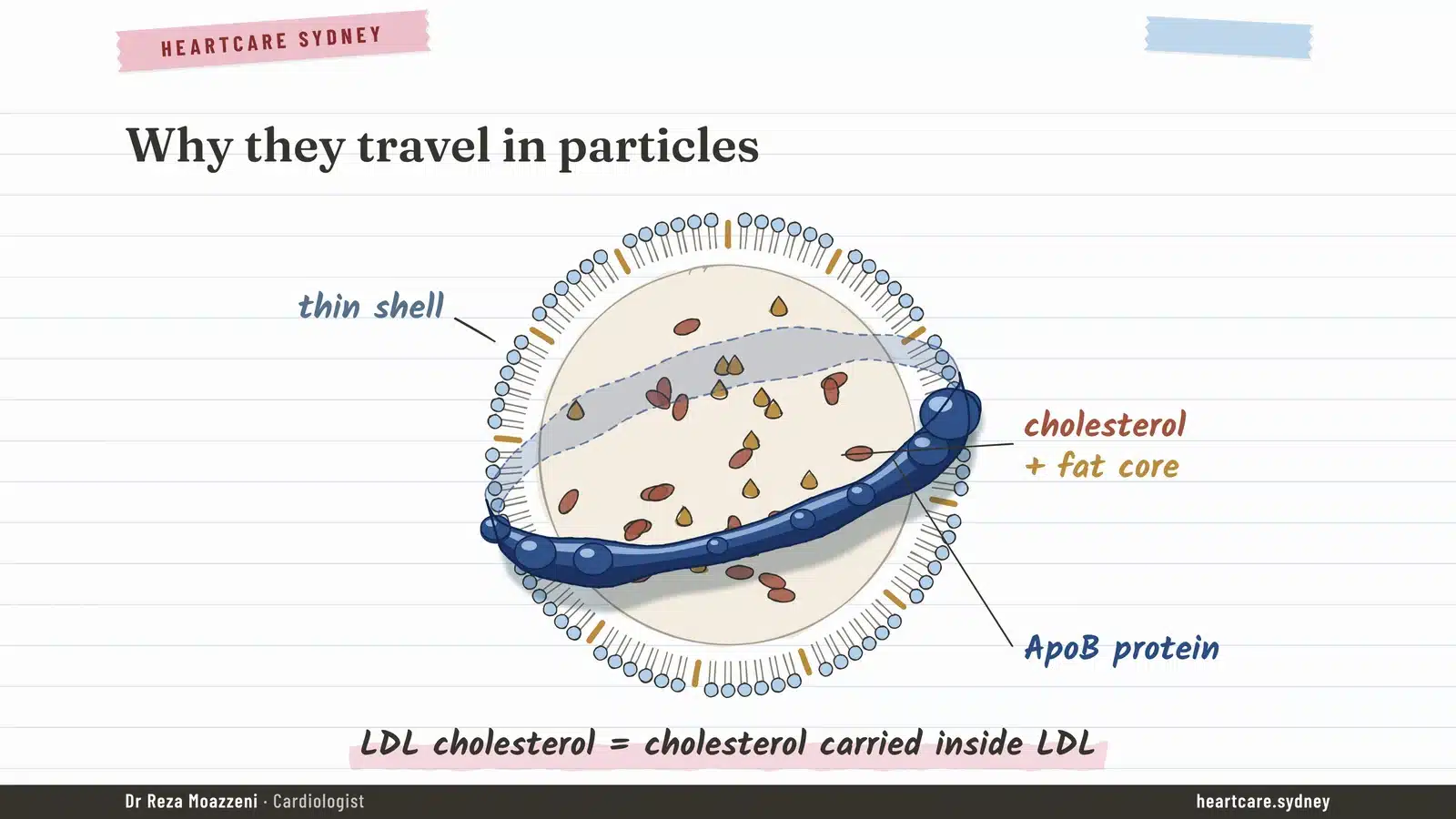
Blood is mostly water. Just as oil floats on water, neither fat nor cholesterol dissolves in blood. So your body packs them into tiny carrier particles called lipoproteins.
Each particle has a thin outer shell, a core of cholesterol and fat, and proteins on the outside. On each LDL particle, that’s one large protein called ApoB.
What the numbers on your blood test mean
- LDL cholesterol is the cholesterol carried inside LDL particles. It isn’t the fat you ate: it’s cholesterol, on its way around the body.
- Triglycerides are the fat travelling in these particles. They are a separate number, and they respond to different changes. Our guide on lowering triglycerides covers them.
New to cholesterol tests? Our beginner’s guide to cholesterol explains the rest of the lipid profile.
How LDL harms your arteries
Your body needs cholesterol. The problem is having too many LDL particles, for too long.
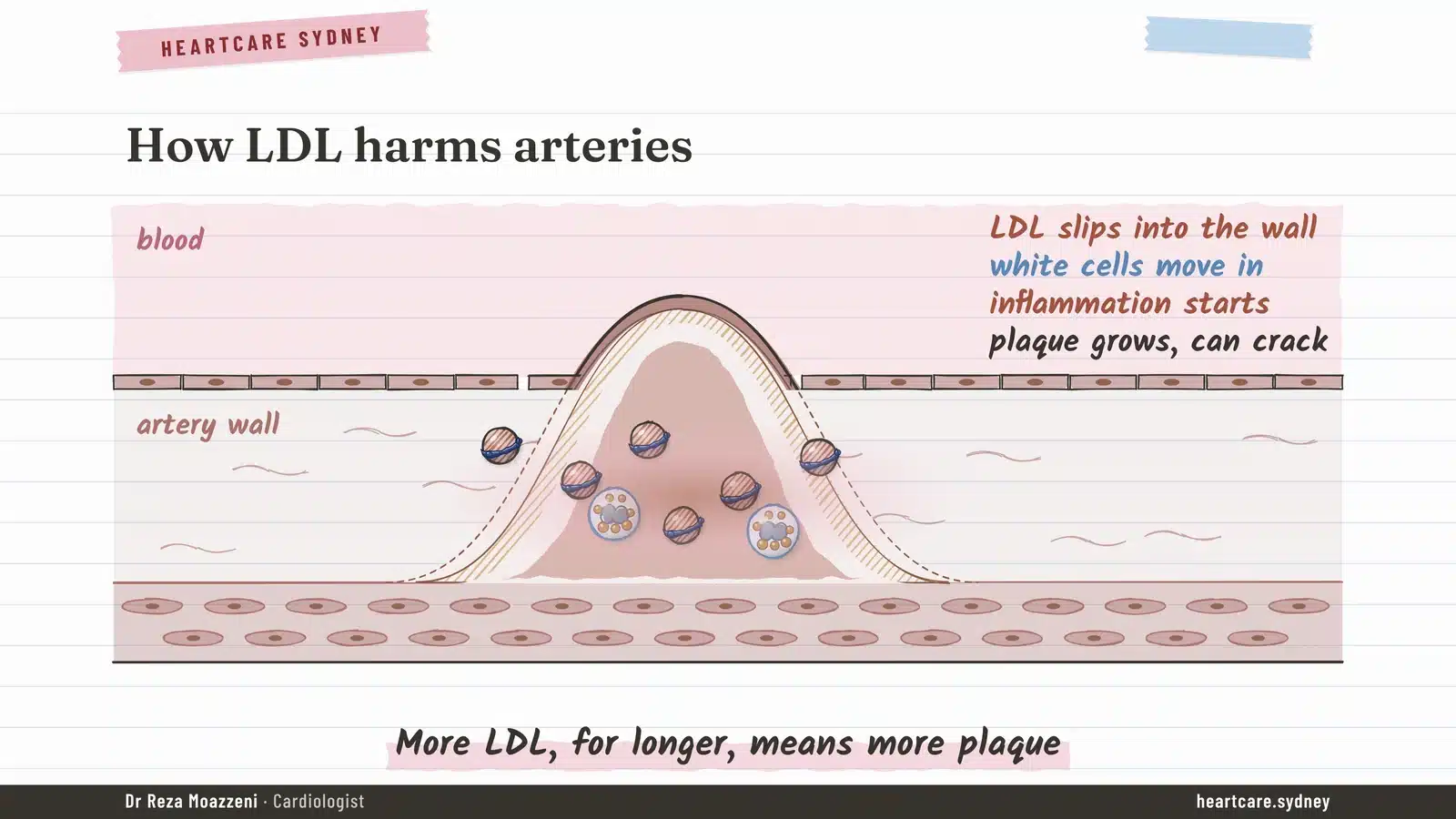
LDL particles slip through the lining of the artery and get trapped inside the wall. White blood cells move in to clear them, fill up with cholesterol, and set off inflammation. Over years, a plaque grows inside the wall. It can narrow the artery, or crack open and set off a clot that causes a heart attack or stroke.
The more LDL you have, and the longer you have it, the more plaque builds up. That’s why lowering LDL lowers the risk of heart attack and stroke.
To read more about how plaque leads to heart attacks and what lowers your risk, see our guide on how to prevent a heart attack.
Not all fats are the same
Fatty-acid chains come in different shapes, and the shape matters.
- Saturated fat has straight chains that pack together tightly. That’s why butter is solid at room temperature.
- Monounsaturated fat has one bend in the chain, and polyunsaturated fat has several. They can’t pack as tightly, so oils like olive and canola stay liquid. Polyunsaturated fats include the omega-3s in oily fish and the omega-6s in nuts and seed oils.
- Trans fat forms when oils are partly hardened in factories, and small amounts occur naturally in meat and dairy. It’s the worst kind for your heart, but on average, Australians eat little of it.
Why saturated fat raises LDL
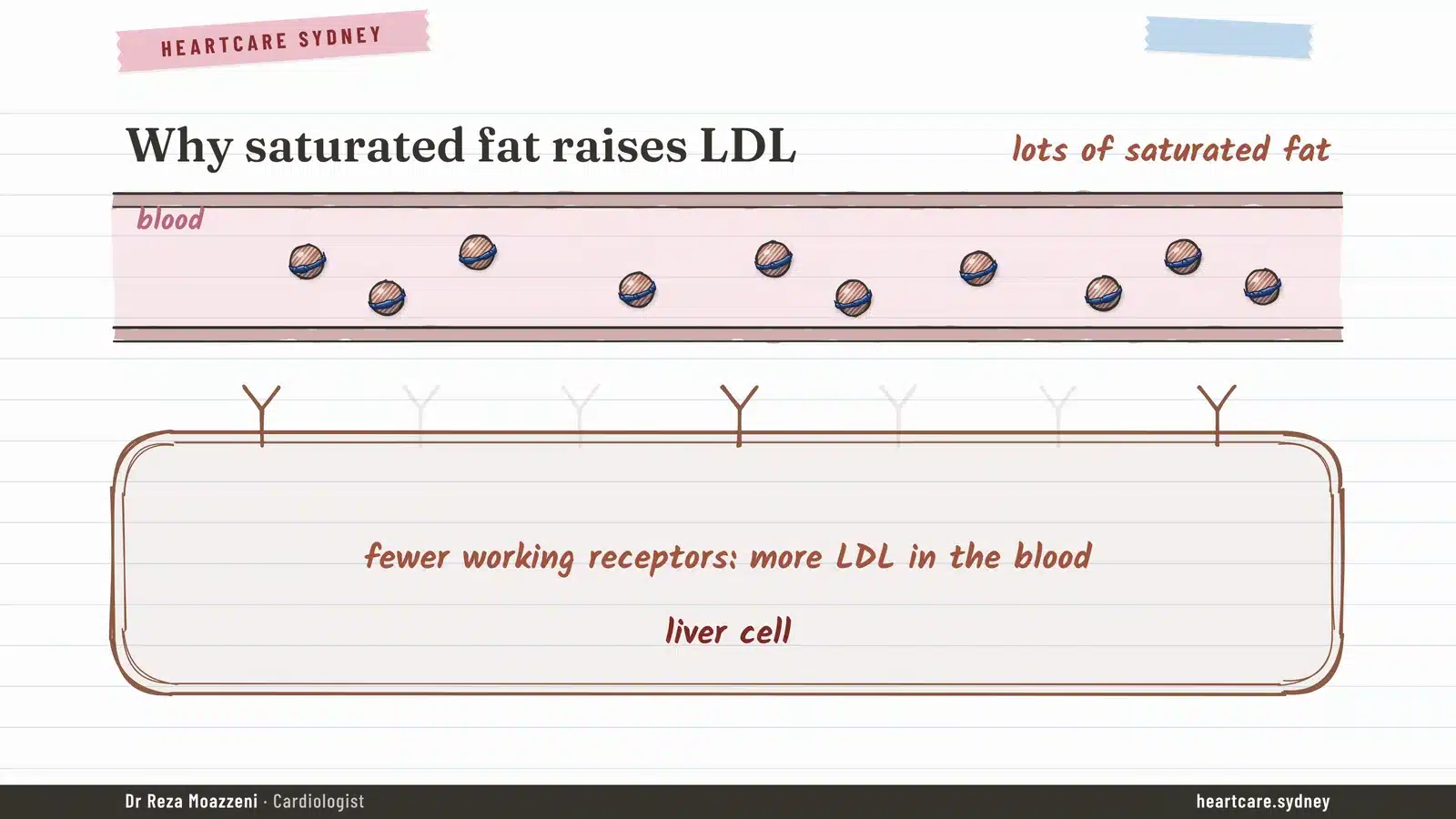
Your liver clears LDL from the blood using LDL receptors: little hooks on the surface of liver cells that catch the particles and pull them in.
When your diet is high in saturated fat, the liver keeps fewer of these receptors working. Fewer particles are caught, so more LDL stays in the blood. When you swap saturated fat for unsaturated fat, the liver clears LDL better again, and LDL comes down.
This matters for your heart, not just your blood test. In long-term trials, eating less saturated fat lowered heart attacks, strokes and other heart and blood-vessel problems, counted together, by about 17%. Put simply, if 56 people without heart disease cut back for about four years, one of them would avoid a heart attack or stroke.
Cholesterol in food matters less than you’d think
This explains a common surprise. Eggs and prawns are high in cholesterol but low in saturated fat, and for most people they raise LDL only a little.
Coconut oil is the opposite. It has no cholesterol at all, yet it’s more than 80% saturated fat, and across trials it raised LDL more than plant oils such as olive and canola.
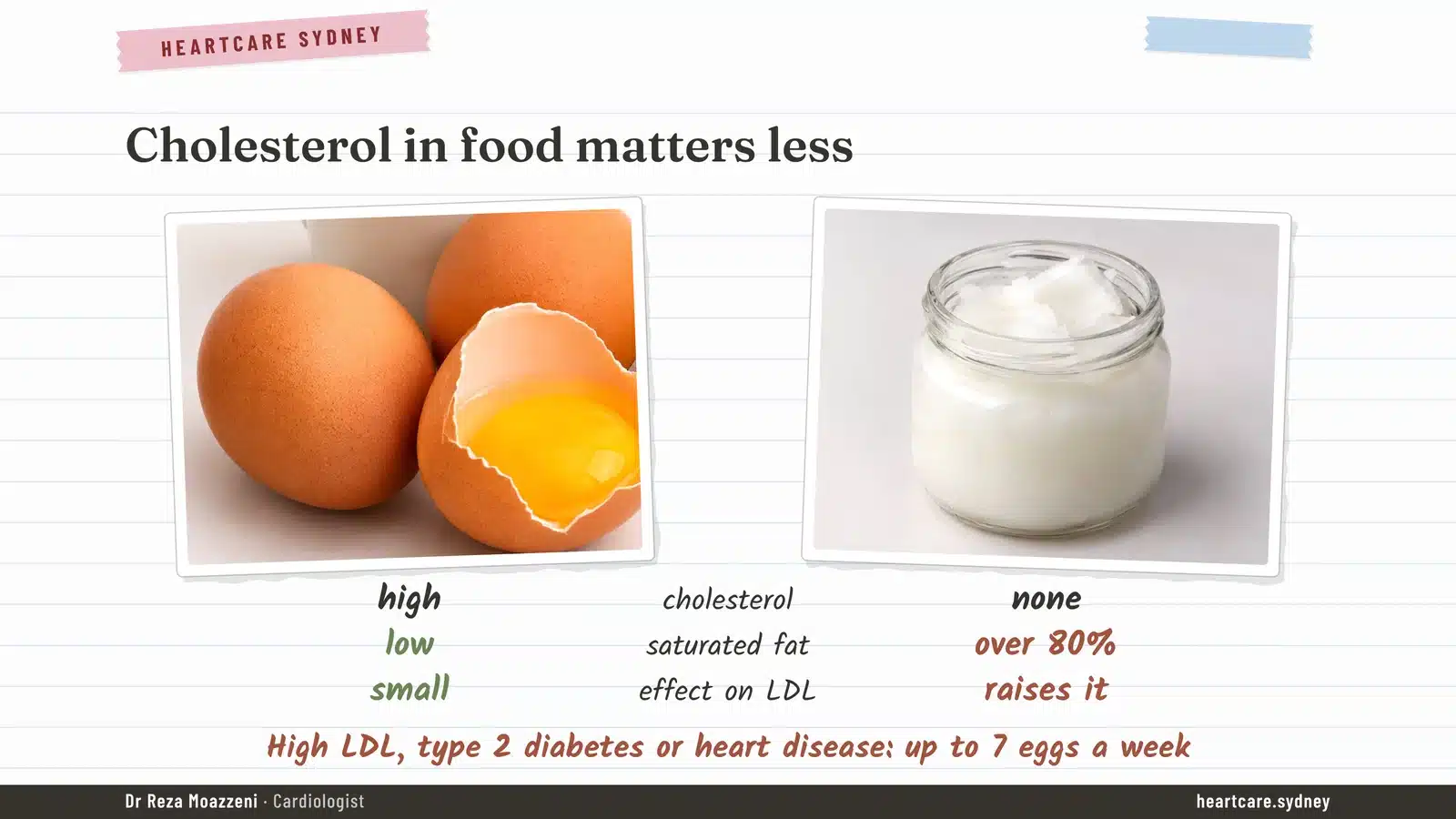
No cholesterol doesn’t mean heart-friendly. A food with no cholesterol can still push your LDL up. On the label, the saturated fat line matters more.
One exception: if you have high LDL, type 2 diabetes or heart disease, the Australian Heart Foundation suggests no more than seven eggs a week. And how you cook them counts too: eggs fried in butter bring their own saturated fat.
Where the fats are
| Mainly saturated fat | Mainly unsaturated fat |
|---|---|
| Butter, ghee and cream | Olive, canola and other plant oils |
| Large amounts of hard cheese | Avocado |
| Fatty and processed meats: sausages, salami, bacon | Nuts and seeds |
| Many pastries and biscuits; some deep-fried takeaway | Oily fish such as salmon and sardines |
| Coconut and palm oil |
Most foods contain a mix of fats. What matters is which kind is the main one, and how much you eat over weeks and months. Watch for saturated fat hiding in foods with a healthy image, such as coconut products and large serves of cheese.
Swap, don’t just cut
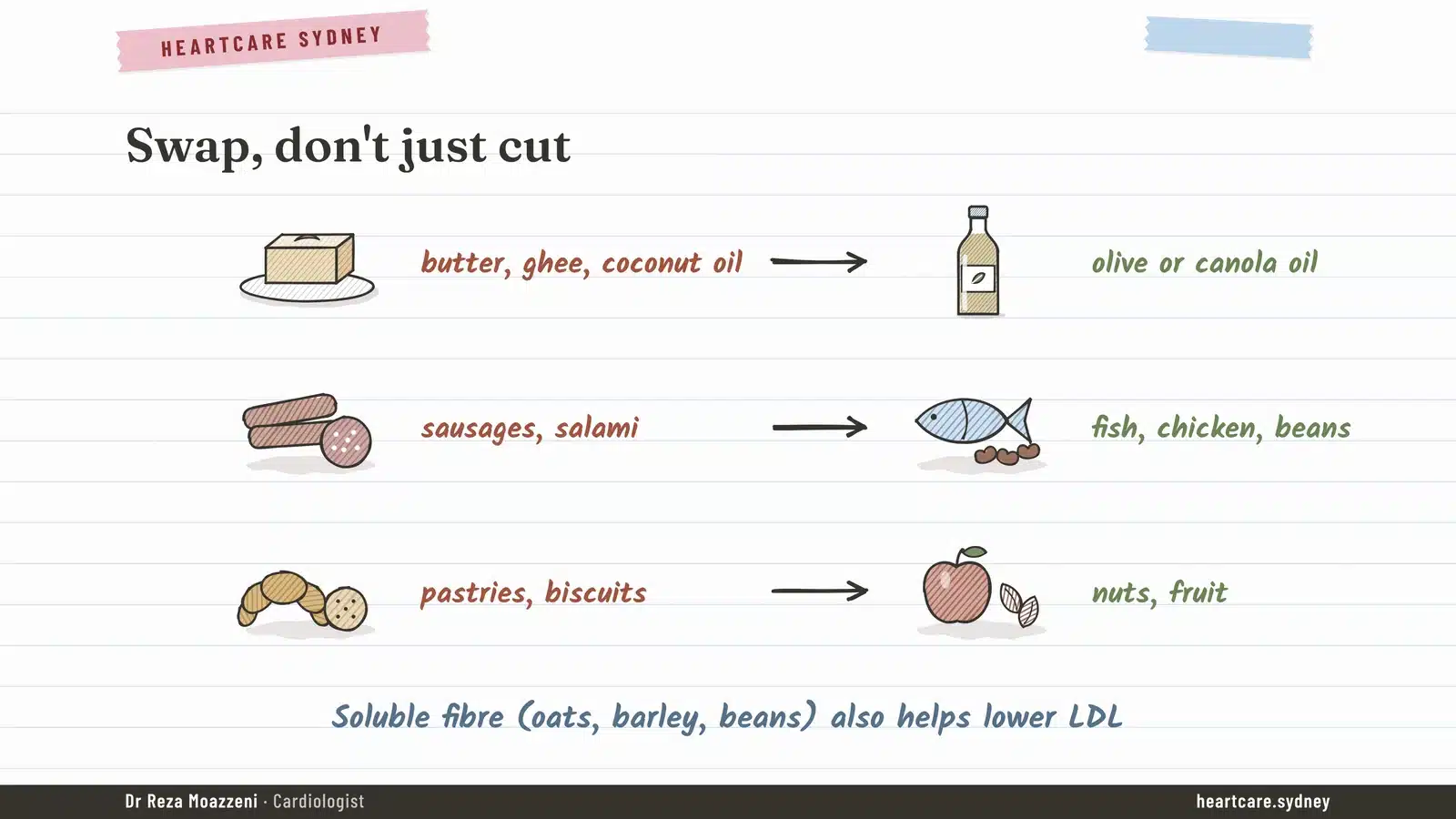
The goal is to swap, not just cut. A few everyday swaps make the biggest difference:
- Cook with olive or canola oil instead of butter, ghee or coconut oil.
- Choose fish, skinless chicken, beans and lentils more often than sausages, salami and fatty meat.
- Snack on nuts and fruit rather than pastries and biscuits.
- Add soluble fibre, in foods such as oats, barley and beans, which also helps lower LDL.
Reading the label
When you shop, look past the total fat on the nutrition panel. Compare the saturated fat per 100 grams between similar products, for example two brands of crackers or two yoghurts.
Replace saturated fat with healthy fats or wholegrains, not sugar. In large studies that followed people for years, swapping saturated fat for sugar or white flour didn’t lower heart risk.
When diet isn’t the whole story
Food is only part of the story. Swapping saturated fat for unsaturated fat usually lowers LDL by about 5–15%, depending on how much you change and on the person. That’s worthwhile, but genes matter too.
- Inherited high cholesterol: roughly 1 in every 250 to 300 people has familial hypercholesterolaemia, which keeps LDL high from childhood, even on a good diet.
- Other medical causes: an underactive thyroid, some kidney or liver conditions, and some medicines can also raise LDL.
Our article What raises LDL cholesterol? goes through each cause, with a checklist of clues and tests.
When to talk to your doctor
- As an adult, your LDL is about 5 mmol/L (190 mg/dL) or higher before any treatment.
- A parent, brother or sister had heart disease young: before about 55 in men or 60 in women.
Even below that, whether your LDL needs treatment depends on your overall heart risk. Ask your GP for a Heart Health Check from 45, or from 30 for Aboriginal and Torres Strait Islander people. You can also browse our cardiovascular risk calculators. Some people need a medicine as well as food changes. That doesn’t mean the food changes have failed. And don’t stop a cholesterol medicine on your own.
An untreated adult LDL of about 5 mmol/L or more warrants assessment for familial hypercholesterolaemia (for example with the Dutch Lipid Clinic Network score) and secondary causes (TSH, renal function and urine protein, liver function, glucose, medication review). Treatment decisions rest on absolute cardiovascular risk, not LDL alone. The effect of dietary change is usually seen on repeat lipids after about 8 to 12 weeks.
- Cholesterol is a waxy building block your body makes itself. It isn’t fat and gives no energy.
- Fat (triglyceride) is mainly fuel. Both are lipids: all fats are lipids, but not all lipids are fats.
- LDL cholesterol is the cholesterol carried inside LDL particles. Too many particles, for too long, build plaque inside the artery wall.
- Saturated fat raises LDL more than the cholesterol in eggs or prawns does.
- Swap, don’t just cut: plant oils, fish, beans, nuts and fruit in place of butter, processed meat and pastries.
- If your numbers stay high, talk to your doctor: genes and other conditions often play a part.
How our clinic can help
At Heartcare Sydney we see many people whose LDL stays high despite careful eating. We look at the whole picture: your family history, the possibility of inherited high cholesterol, other medical causes, and your overall risk of heart attack and stroke. Then we work out, with you and your GP, whether food changes alone are enough or whether a medicine would help. Our consultations are available in English and Persian (Farsi). For a closer look at the causes of high LDL, read our article on what raises LDL cholesterol.
To read more, see our articles on ApoB vs LDL cholesterol, Lp(a) and the coronary artery calcium score. If high cholesterol runs in your family, see our guide to familial hypercholesterolaemia. When a statin isn’t enough, our articles on PCSK9 inhibitors and inclisiran explain the next options. For how the thresholds work, see our summary of the 2026 ACC/AHA dyslipidaemia guidelines.
LDL that won’t budge?
Dr Reza Moazzeni is a consultant cardiologist in Westmead and at Sydney Adventist Hospital. If your LDL stays high despite lifestyle changes, is about 5 mmol/L or higher, or heart disease runs young in your family, an assessment can help decide the next step. A GP referral is required.
Book an appointmentFrequently asked questions
Is cholesterol a type of fat?
No. Cholesterol and fat are both lipids, but they’re different substances. Cholesterol is a waxy, ring-shaped sterol your body uses as a building block for cells, some hormones and bile acids. Fat, mostly triglyceride, is fuel. Cholesterol gives you no energy.
Do eggs raise cholesterol?
For most people, only a little. Eggs are high in cholesterol but low in saturated fat. If you have high LDL, type 2 diabetes or heart disease, the Australian Heart Foundation suggests no more than seven eggs a week. Cooking them in butter adds saturated fat.
Is coconut oil good for cholesterol?
No. Coconut oil has no cholesterol, but it’s more than 80% saturated fat, and in trials it raised LDL more than plant oils such as olive and canola.
How much can diet lower LDL?
Swapping saturated fat for unsaturated fat usually lowers LDL by about 5–15%, depending on how much you change and on the person. Adding soluble fibre helps a little more. Give the changes about 8 to 12 weeks before a repeat blood test.
Why is my LDL still high when I eat well?
Genes play a big part. About 1 in 250 to 300 people has familial hypercholesterolaemia, and many more have a milder inherited tendency. An underactive thyroid, some kidney or liver conditions and some medicines can also raise LDL. Saturated fat can also hide in foods with a healthy image, such as coconut products and cheese. Talk to your doctor.
Main sources
- Hooper L, Martin N, Jimoh OF, et al. Reduction in saturated fat intake for cardiovascular disease. Cochrane Database Syst Rev (2020);(8):CD011737.
- Carson JAS, Lichtenstein AH, Anderson CAM, et al. Dietary Cholesterol and Cardiovascular Risk: A Science Advisory From the American Heart Association. Circulation (2020);141(3):e39–e53.
- Neelakantan N, Seah JYH, van Dam RM. The Effect of Coconut Oil Consumption on Cardiovascular Risk Factors. Circulation (2020);141(10):803–814.
- National Heart Foundation of Australia. Position statements on dietary fat and eggs (2019).
- Nelson AJ, Nicholls SJ. Managing hypercholesterolaemia. Australian Prescriber (2024).
This article is general information, not personal medical advice. Please don’t start, stop or change any medicine without talking to your doctor. The illustrations are schematic. Information current at November 2026.