
Two people can have exactly the same LDL cholesterol result and very different numbers of the particles that build plaque in their arteries. That is why more doctors are now ordering a test called ApoB. It sounds like yet another kind of cholesterol, but it isn’t: in effect, it counts the particles that carry cholesterol around your body. Here we explain, in plain language, what ApoB is, how it differs from LDL cholesterol, and who should ask about it.
Cholesterol needs a ride
Cholesterol is a waxy, fat-like substance. Your body needs it to build cells and make hormones, but like oil in water it doesn’t mix with blood, so it can’t simply float around on its own.
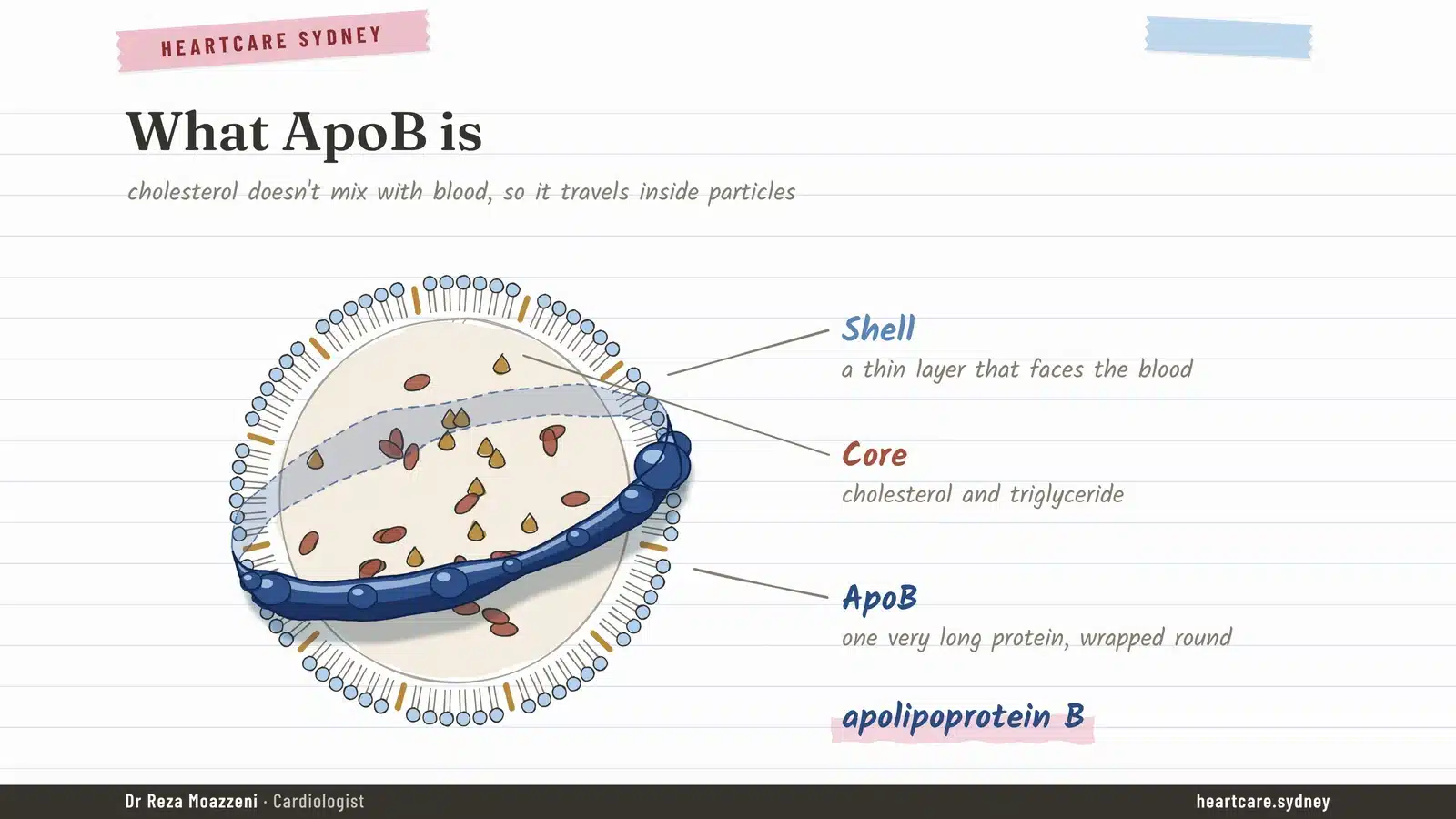
Instead, cholesterol travels inside tiny particles called lipoproteins. You can picture each one as a small parcel. In the middle is a core of cholesterol and triglyceride (the main fat in our food and in body fat). Around the core is a thin shell that faces the blood. And wrapped around the outside of the shell is one very long protein. That protein is apolipoprotein B, or ApoB for short.
One ApoB per particle: why it works as a count
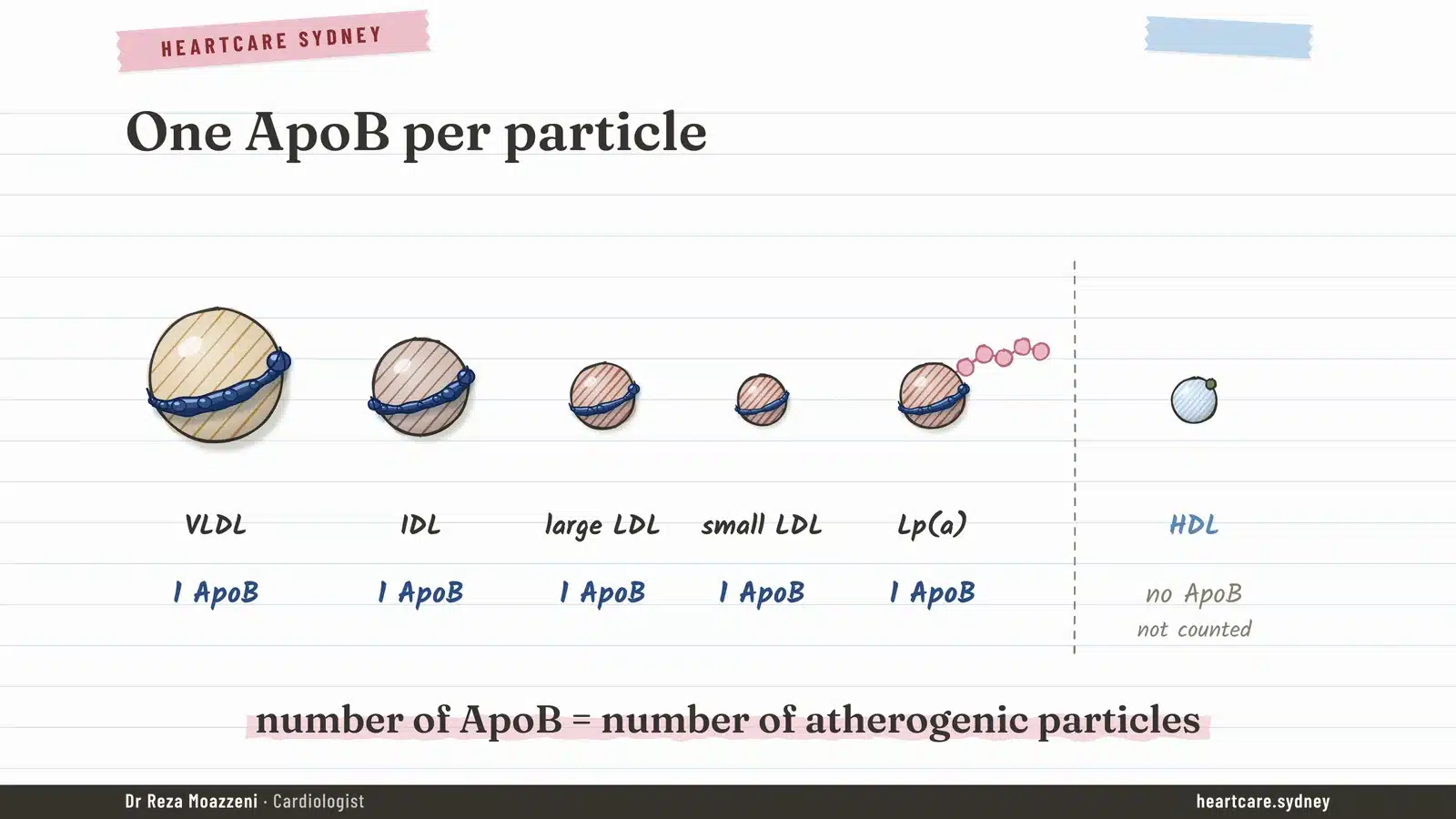
This is the single most useful fact about ApoB. Every one of the particles that can clog arteries carries exactly one ApoB, no more and no less. It doesn’t matter whether the particle is big or small, packed with cholesterol or nearly empty: each one has a single ApoB on it.
The family includes VLDL, IDL, LDL and Lp(a). The letters stand for different densities, but you don’t need to remember them. What matters is that, because there is one ApoB per particle, measuring the ApoB in your blood is in effect a count of these particles. Doctors call them atherogenic particles, meaning the ones that can build up in artery walls.
HDL, the so-called good cholesterol, is different. It carries a different protein, so it isn’t counted in an ApoB test.
Number of ApoB = number of particles that can build plaque. ApoB isn’t a new type of cholesterol; it’s a particle count.
Where ApoB particles come from
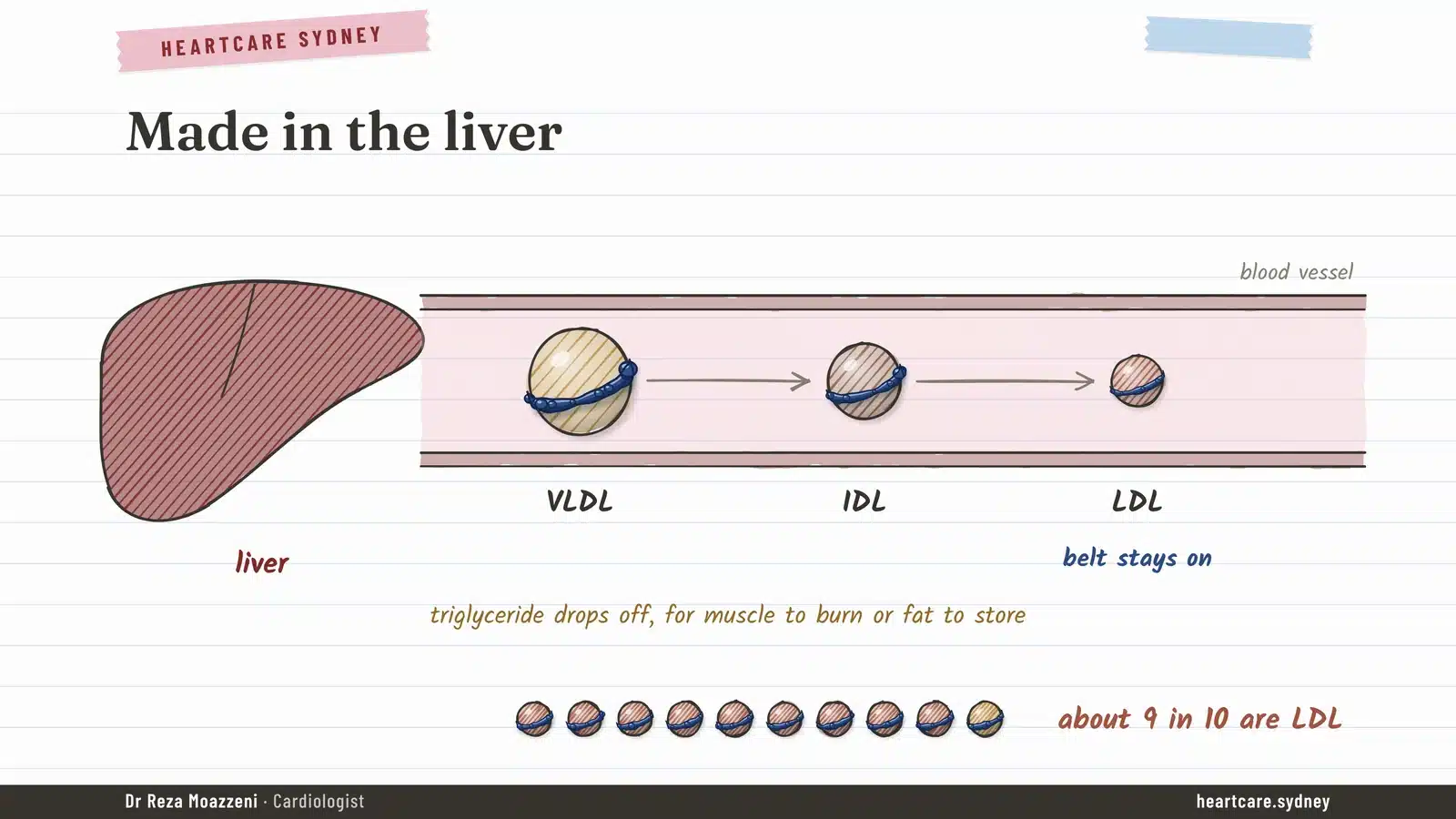
ApoB is made in the liver. The liver wraps one ApoB around each new particle and releases it into the bloodstream. These new particles start out large and rich in triglyceride; they are called VLDL.
As they circulate, they drop off triglyceride for your muscles to burn or for fat tissue to store. As they lose it, they shrink, first to IDL and then, for many of them, to LDL. The ApoB stays on the whole way. In most people, about 9 in every 10 ApoB particles in the blood are LDL, which is why LDL dominates the conversation.
What ApoB does
ApoB has two jobs. First, it holds the particle together, a bit like a frame. Second, it is the key the liver uses to take particles back out of the blood. ApoB fits a receptor on the surface of liver cells, called the LDL receptor. The particle docks, is pulled inside the cell and is broken down. Several cholesterol-lowering medicines, statins among them, work by increasing the number of these receptors on the liver, so more particles are cleared.
Why the number of particles matters
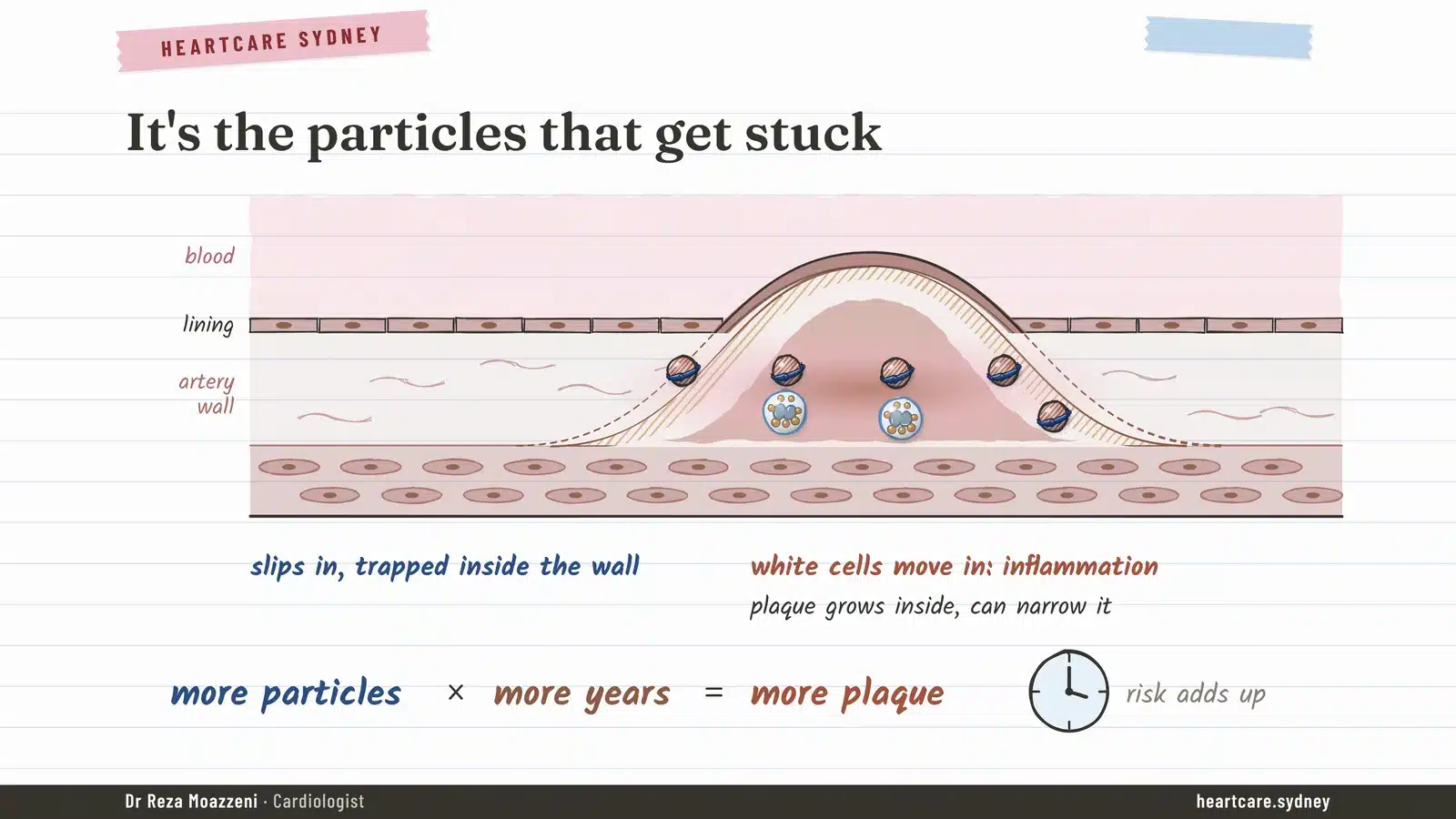
It is the particles themselves that do the damage. As they stream along an artery, some slip through the inner lining into the artery wall. Once inside, ApoB sticks to the tissue of the wall and the particle becomes trapped.
The body treats these trapped particles as intruders. White blood cells move in from the blood to swallow them and fill up with fat, and inflammation begins inside the wall. Over many years, trapped particles and white cells build a plaque inside the wall. The plaque can slowly grow until it narrows the artery, and a plaque that becomes unstable can trigger a heart attack or stroke.
So the risk depends on two things: how many particles are in the blood, and for how many years they stay high. More particles, for more years, means more of them get stuck.
To read more about how plaque leads to heart attacks and what lowers your risk, see our guide on how to prevent a heart attack.
Same LDL cholesterol, different number of particles
This is where ApoB and LDL cholesterol part ways, and it is the part most people find confusing.
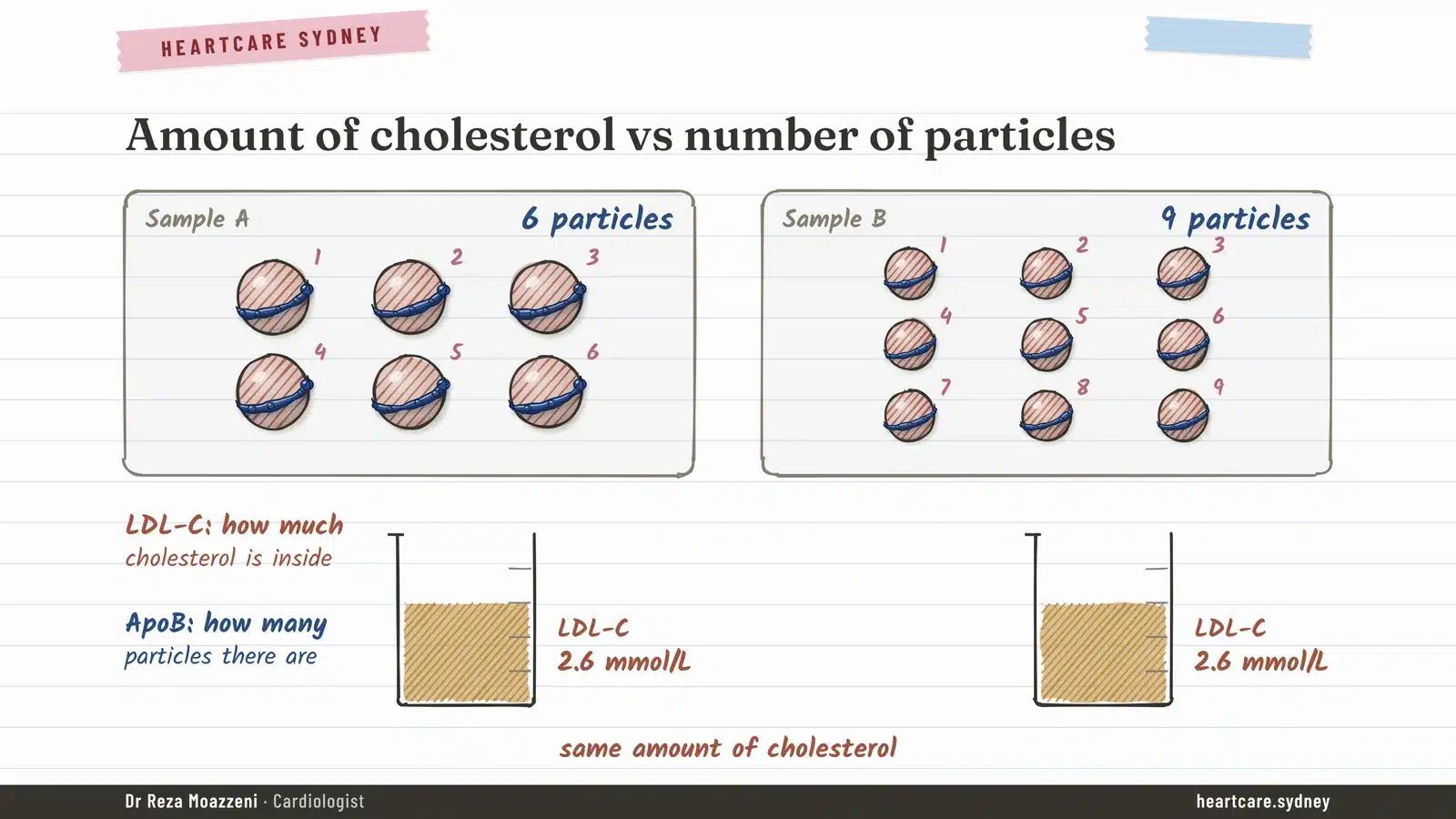
A standard LDL cholesterol result measures how much cholesterol is carried inside your LDL particles. It doesn’t tell you how many particles that cholesterol is spread across. Imagine two blood samples holding exactly the same amount of LDL cholesterol. In one, it is packed into 6 large particles. In the other, the same amount is spread across 9 smaller particles. Both samples give the same LDL cholesterol result, but the second has 50% more particles, and so more chances for particles to slip into the artery wall.
LDL cholesterol measures how much cholesterol is inside the particles. ApoB counts the particles themselves.
A worked example
Take two made-up people, Sam and Alex. Both have an LDL cholesterol of 2.6 mmol/L, so on that result alone they look the same. But Sam’s ApoB is 0.75 g/L, while Alex’s is 0.95 g/L. That means Alex has about a quarter more of these particles in the blood, passing the artery wall every day, for years.
Large genetic and population studies have found that risk follows the particle count more closely than the cholesterol. When the two numbers point in different directions, ApoB is the better guide.
When the two numbers disagree
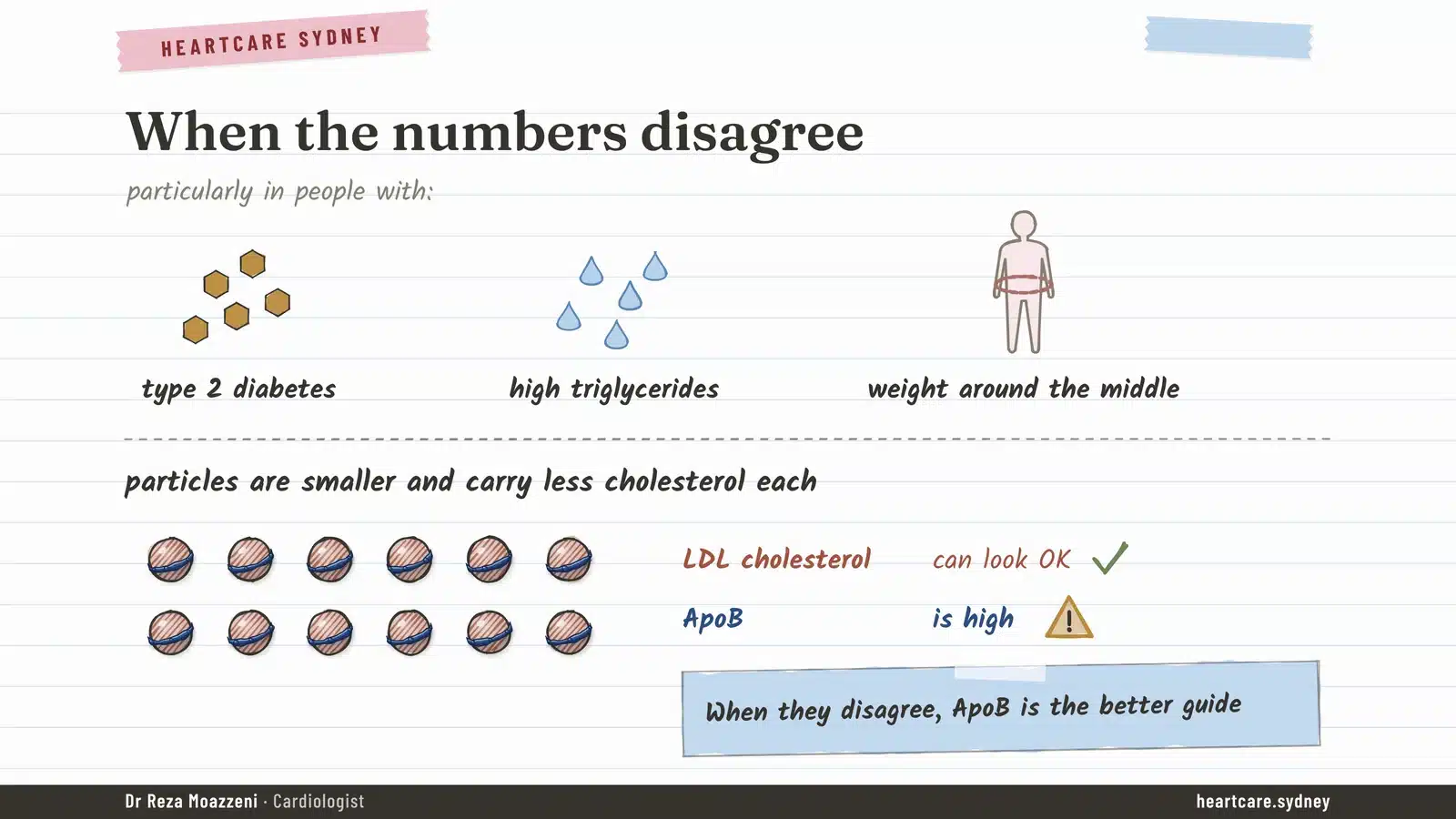
In many people, ApoB and LDL cholesterol tell the same story. But ApoB can be higher than the LDL result suggests, particularly in people with:
- type 2 diabetes
- high triglycerides
- extra weight around the middle
In these conditions, the particles tend to be smaller and each one carries less cholesterol. The LDL cholesterol result can then look reassuring while the number of particles is actually high. If that is you, an ApoB test can uncover risk that the standard cholesterol test misses, and it is a good reason to talk with your doctor about your overall risk.
How ApoB is measured
ApoB is a simple blood test, and it can usually be done at the same time as your cholesterol test. The result comes back in grams per litre (g/L). In Australia, ApoB testing isn’t covered by Medicare, so pathology labs usually charge a small out-of-pocket fee; your doctor or the lab can tell you the cost.
Do I need to fast?
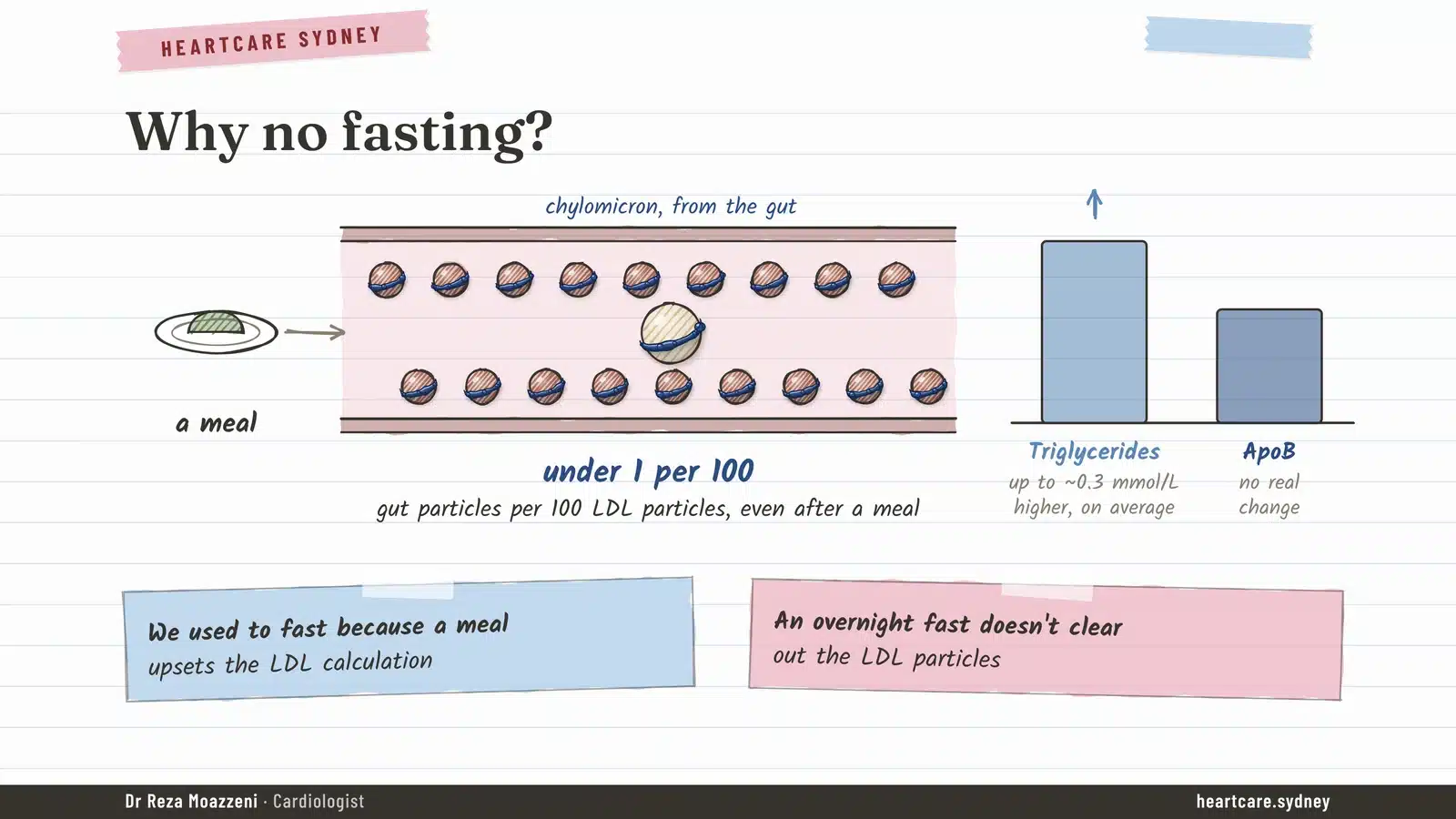
Usually not, unless your doctor or the request form asks you to. Doctors used to ask for fasting mainly because a meal raises triglycerides, and high triglycerides upset the formula many labs use to calculate LDL cholesterol. Today, most cholesterol and ApoB tests can be done without fasting.
A meal adds very few particles. Fat from food enters the blood in large particles called chylomicrons, and each of these also carries one ApoB (a shorter form made in the gut). But even after a meal, healthy people usually have fewer than 1 gut particle for every 100 LDL particles. A typical meal raises triglycerides by up to about 0.3 mmol/L on average, while ApoB barely changes. An overnight fast doesn’t clear out the LDL particles, so the ApoB result stays much the same either way.
What are the ApoB goals?
European guidelines use ApoB as an extra check alongside LDL cholesterol, with goals that depend on your overall risk of heart attack and stroke:
| Your risk group | European ApoB goal (2019, unchanged in 2025) |
|---|---|
| Moderate risk | Below 1.0 g/L |
| High risk | Below 0.8 g/L |
| Very high risk (for example, after a heart attack) | Below 0.65 g/L |
The newest American guideline, from March 2026, lists lower goals by risk: below 0.9, 0.7 or 0.55 g/L. It suggests checking ApoB once LDL cholesterol is at goal, especially in people with high triglycerides, diabetes or heart disease. Your doctor can tell you which risk group you are in.
- ESC/EAS 2019 secondary ApoB goals (unchanged in the 2025 focused update): <100, <80 and <65 mg/dL for moderate, high and very high risk.
- The 2026 ACC/AHA multisociety guideline lists ApoB goals of <90, <70 and <55 mg/dL by risk category. Measuring ApoB is reasonable to guide further intensification once LDL-C and/or non-HDL-C goals are met, particularly with ASCVD, cardiovascular-kidney-metabolic syndrome, type 2 diabetes or elevated triglycerides. US and European risk categories aren’t interchangeable.
- Non-fasting sampling is appropriate for ApoB (EAS/EFLM); consider repeating fasting if non-fasting triglycerides are ≥4.5 mmol/L.
- ApoB is not MBS-rebatable in Australia (MSAC application 1512 was not supported).
Who should ask about ApoB?
An ApoB test is most useful if you:
- have type 2 diabetes, high triglycerides or carry weight around the waist, where LDL cholesterol can underestimate the particle count
- are on treatment and have reached your LDL cholesterol target, to check that the particle count has come down too
ApoB doesn’t measure Lp(a) separately. Lp(a) is one of the particles ApoB counts, but its own level is worth checking once in a lifetime; our guide to Lp(a) explains why. A coronary artery calcium score can also help show whether plaque has already formed.
What lowers ApoB?
The good news is that the same things that lower LDL cholesterol also lower ApoB:
- swapping saturated fat (fatty meat, butter, coconut oil, many takeaway foods) for healthier fats such as olive oil, nuts and fish
- losing excess weight, especially around the waist
- being physically active most days
- when needed, medicines, usually starting with a statin; other medicines can be added if the levels stay high
Lowering the number of particles, and keeping it low for years, means fewer particles get trapped in your artery walls. Please don’t stop or change a medicine on your own: talk to your doctor first. For more on what pushes LDL up in the first place, see what actually raises your LDL.
- Cholesterol travels in particles. Each particle that can build plaque carries exactly one ApoB, so ApoB is in effect a particle count.
- LDL cholesterol measures how much cholesterol is inside the particles; ApoB counts the particles themselves.
- Particles slip into the artery wall, get trapped and trigger inflammation; more particles for more years means more plaque.
- ApoB can be high when LDL cholesterol looks fine, especially with diabetes, high triglycerides or weight around the middle. When they disagree, ApoB is the better guide.
- It’s a simple blood test, usually without fasting. European goals are below 1.0, 0.8 or 0.65 g/L depending on your risk.
How our clinic can help
At Heartcare Sydney we look at your whole picture, not a single number. We review your cholesterol and ApoB results alongside your blood pressure, blood sugar, family history and, where useful, a coronary calcium score, and we explain what your results mean for you. If your ApoB and LDL cholesterol don’t agree, we can help you decide whether treatment needs to change. Our consultations are available in English and Persian (Farsi).
For more on related tests, read our articles on Lp(a) and the coronary artery calcium score. If high cholesterol runs in your family, see our guide to familial hypercholesterolaemia. When a statin isn’t enough, our articles on PCSK9 inhibitors, inclisiran and the new oral PCSK9 tablets explain the next options.
Want to know what your numbers mean?
Dr Reza Moazzeni is a consultant cardiologist in Westmead and at Sydney Adventist Hospital. If your ApoB and LDL cholesterol don’t agree, or you’re unsure what your results mean for you, an assessment can help decide the next step. A GP referral is required.
Book an appointmentFrequently asked questions
Is ApoB a type of cholesterol?
No. ApoB is a protein. Each particle that can build plaque in the arteries carries one ApoB, so measuring ApoB is in effect a count of these particles. LDL cholesterol measures the amount of cholesterol inside them.
Is ApoB better than LDL cholesterol?
For most people the two give the same message. ApoB is more accurate when they disagree, for example in type 2 diabetes, high triglycerides or weight around the middle, where LDL cholesterol can look normal while the number of particles is high. Large studies show risk follows the particle count more closely.
Do I need to fast for an ApoB test?
Usually not, unless your doctor or the request form asks you to. A meal mainly raises triglycerides and adds very few particles, so the ApoB result barely changes.
What is a normal ApoB level?
There isn’t one target for everyone. European guidelines suggest an ApoB below 1.0 g/L for people at moderate risk, below 0.8 g/L at high risk and below 0.65 g/L at very high risk, such as after a heart attack. Your doctor can tell you which group you are in.
How can I lower my ApoB?
The same measures that lower LDL cholesterol also lower ApoB: swapping saturated fat for healthier fats, losing excess weight, being active and, when needed, medicines, usually starting with a statin. Don’t stop or change a medicine without talking to your doctor.
Main sources
- 2019 ESC/EAS Guidelines for the management of dyslipidaemias, Eur Heart J (2019), and the 2025 Focused Update, Eur Heart J (2025).
- 2026 ACC/AHA/Multisociety Guideline on the Management of Dyslipidemia, JACC (March 2026).
- Sniderman et al., JAMA Cardiology 2019.
- Ference et al., JAMA 2019.
- Johannesen et al., JACC 2021.
- Borén et al., EAS consensus statement, Eur Heart J 2020.
- Nordestgaard et al., EAS/EFLM consensus statement, Eur Heart J 2016.
- Langlois et al., EAS/EFLM consensus recommendations, 2020.
This article is general information, not personal medical advice. Please don’t start, stop or change any medicine without talking to your doctor. The illustrations are schematic and not to scale, and the worked example is made up. Information current at November 2026.