
For most people, lowering LDL (“bad”) cholesterol starts with a statin tablet. When that isn’t enough, the next strongest options have so far been injections that block a protein called PCSK9. Two tablets that target the same protein are now in late development or newly approved overseas: enlicitide, from MSD, and laroprovstat, from AstraZeneca. Both cut LDL cholesterol by about half in trials. They work in different ways, and there is still an important question they haven’t answered yet.
How your liver clears LDL cholesterol
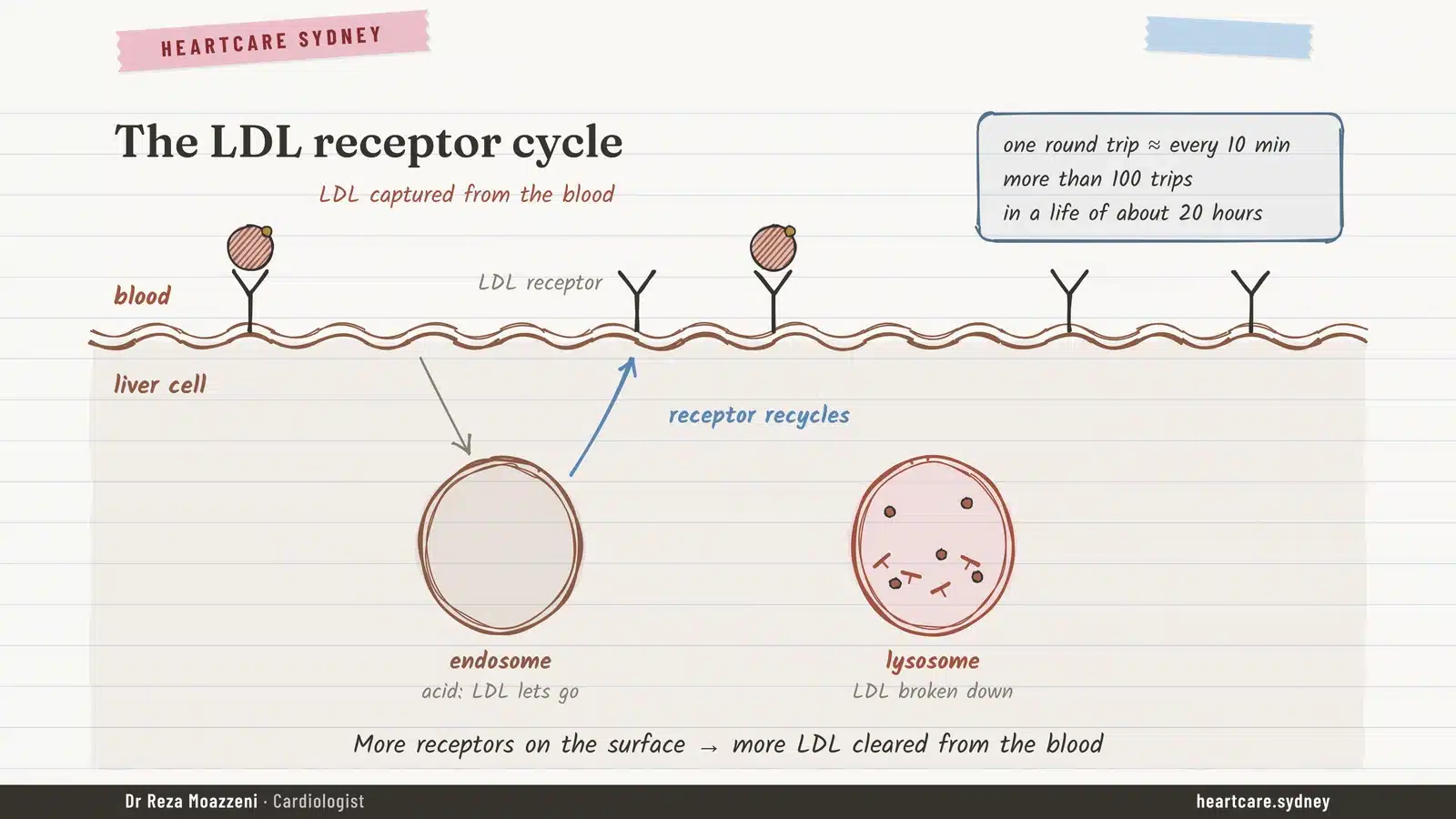
LDL cholesterol travels in the blood inside tiny particles. Your liver is the main organ that removes them. It does this with LDL receptors: small “catchers” that sit on the surface of every liver cell.
Each receptor grabs an LDL particle and pulls it into the cell inside a small bubble called an endosome. The inside of that bubble turns acidic, and the acid makes the receptor let go. The LDL is then sent to the lysosome, the cell’s recycling centre, where it is broken down. The empty receptor goes back to the surface to catch another particle.
One trip takes about 10 minutes, and a receptor can make more than 100 trips before it wears out. So the number of receptors on the surface decides how quickly LDL is cleared from your blood. More receptors means lower LDL.
What PCSK9 does
PCSK9 is a protein made mainly by the liver and released into the blood. It latches on to LDL receptors at the cell surface and gets pulled into the cell with them.
Inside the acidic endosome, PCSK9 holds on even tighter. The receptor can no longer let go and return to the surface. Instead, PCSK9 escorts it to the lysosome, where the receptor is destroyed along with everything else. PCSK9 doesn’t cut up the receptor itself; it simply steers it the wrong way.
The result: fewer receptors make it back to the surface, less LDL is removed, and LDL in the blood rises. That is why blocking PCSK9 lowers cholesterol so effectively.
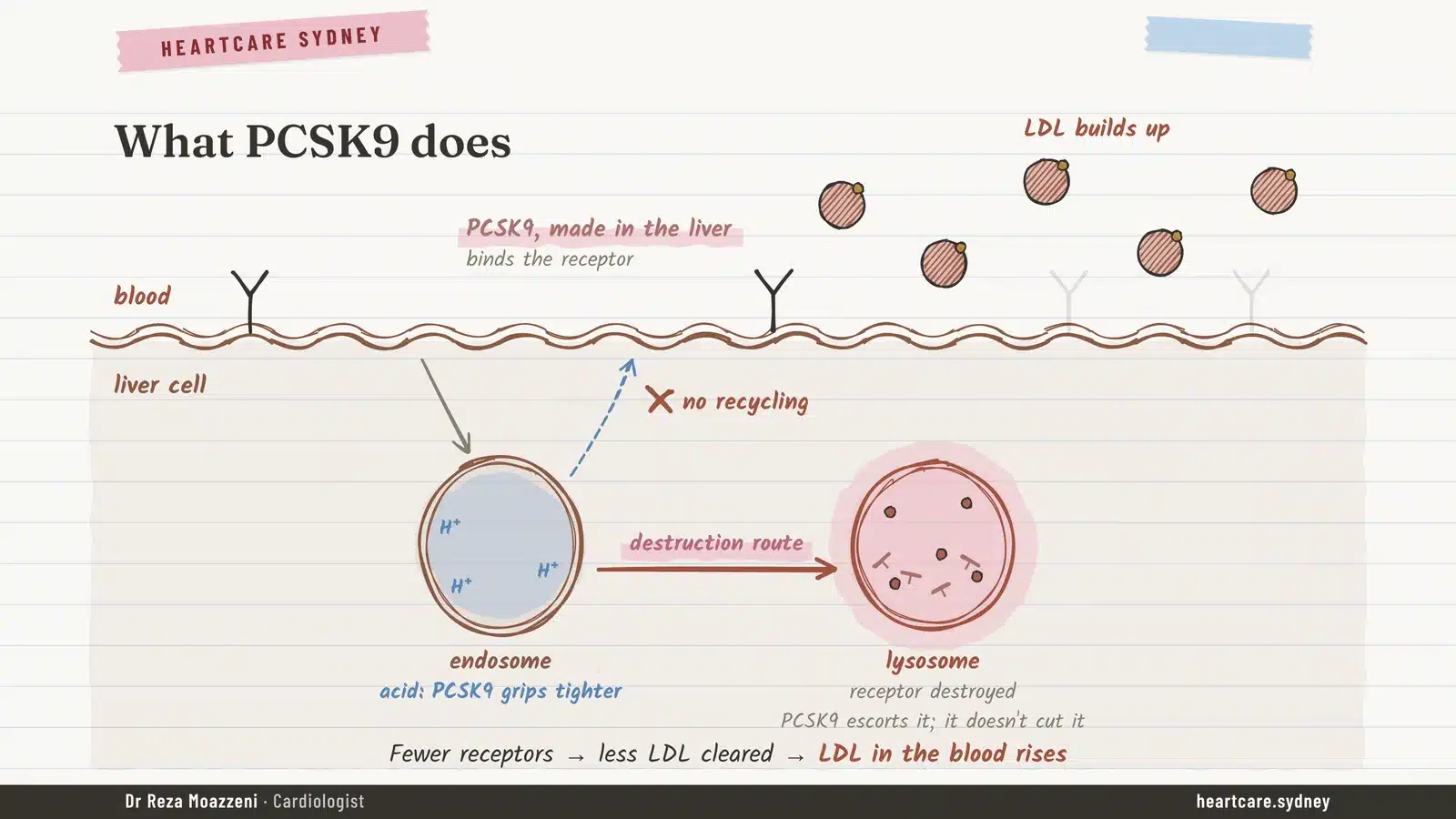
PCSK9 doesn’t attack cholesterol directly. It reduces the number of LDL receptors, so the liver clears less LDL.
Two tablets, two different steps
Both medicines stop PCSK9 from destroying LDL receptors. The difference is where in the process they step in.
Enlicitide: stops PCSK9 attaching
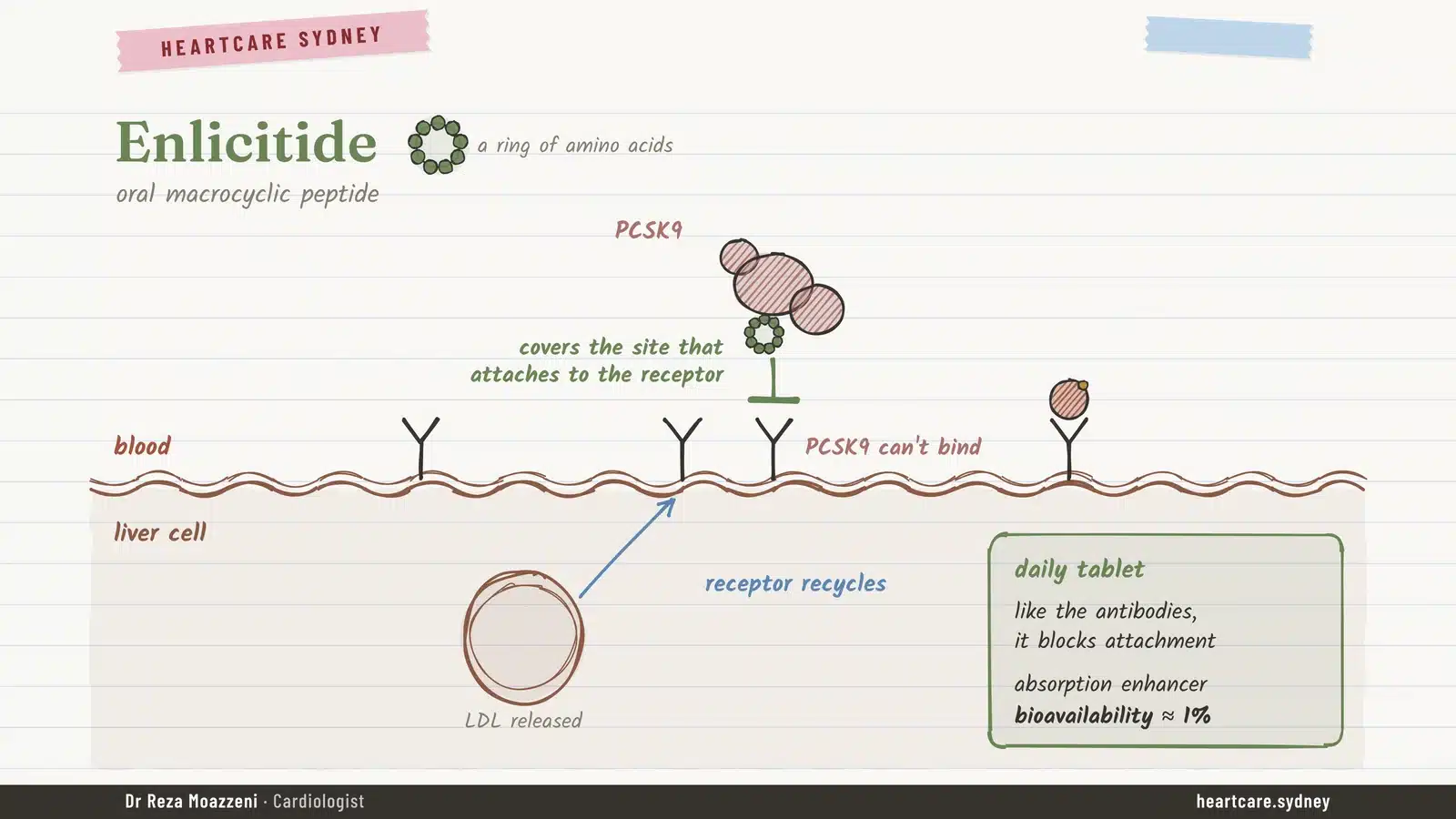
Enlicitide is a macrocyclic peptide: a small ring of amino acids, the building blocks of proteins, designed so it can be taken by mouth. It sticks to the exact part of PCSK9 that would normally attach to the LDL receptor. With that spot covered, PCSK9 can’t grab the receptor at all.
The receptor carries on as normal: it captures LDL, releases it inside the cell, and returns to the surface. This is the same idea as the PCSK9 antibody injections, but in a daily tablet.
Peptides are hard to absorb from the gut. To get around this, the tablet contains an absorption enhancer. Even so, only about 1% of each dose reaches the bloodstream, which is why the way you take it matters (more on that below).
Laroprovstat: lets PCSK9 attach, then blocks the destruction route
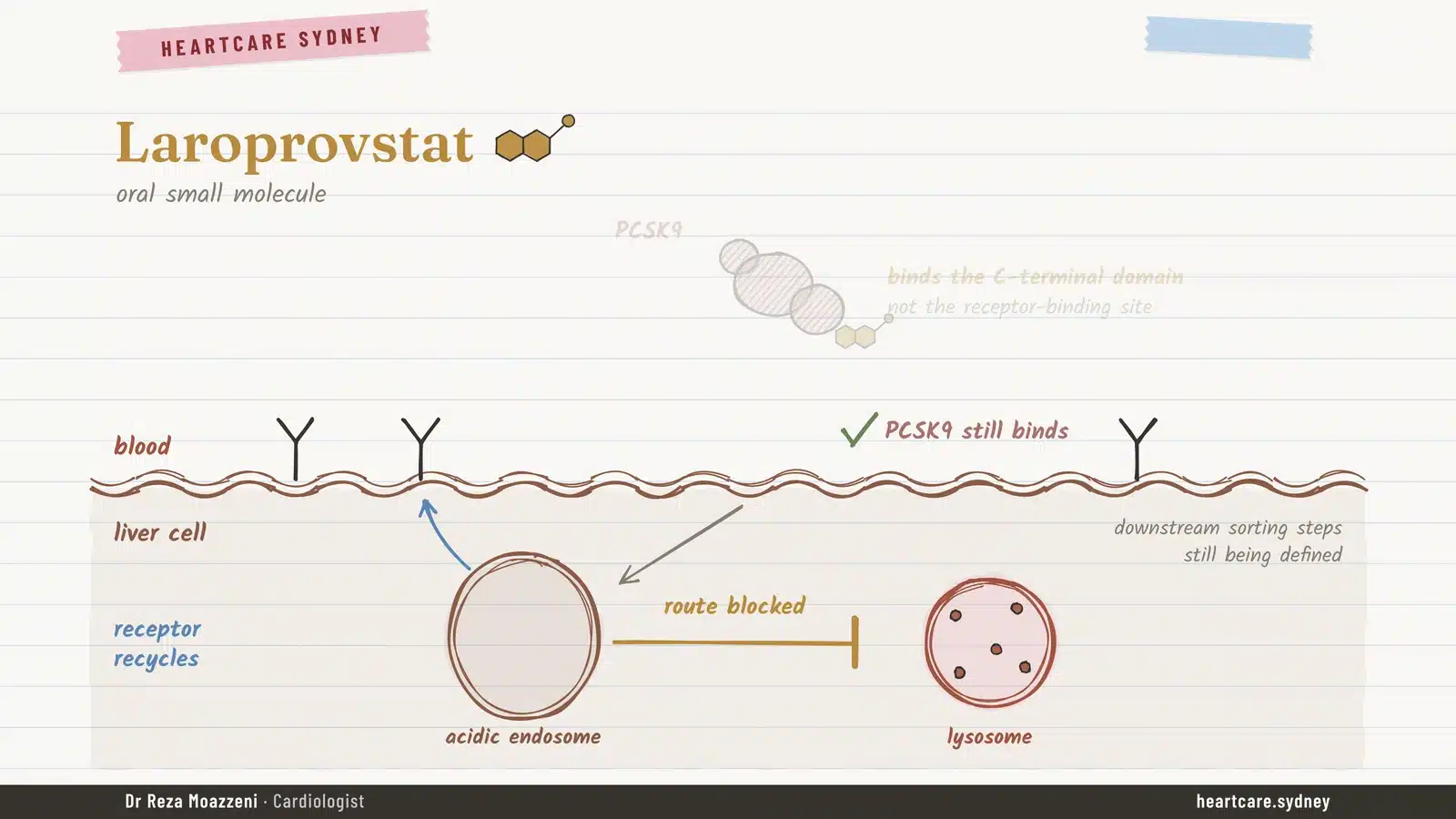
Laroprovstat works differently. It is a small molecule, like most everyday tablets, and it binds a different part of PCSK9: its tail end, called the C-terminal domain.
With laroprovstat on board, PCSK9 still attaches to the receptor, and the pair are still pulled into the cell together. The difference comes next. Inside the acidic endosome, laroprovstat holds that tail end steady and interferes with the next step: the trip to the lysosome. The receptor escapes destruction and goes back to the surface. Scientists are still working out the exact sorting steps involved.
Side by side
Think of it as two checkpoints on one road. Enlicitide works before attachment, at the cell surface. Laroprovstat works after attachment, inside the cell. Both lead to the same place: more receptors back on the surface, more LDL captured from the blood, and lower LDL cholesterol.
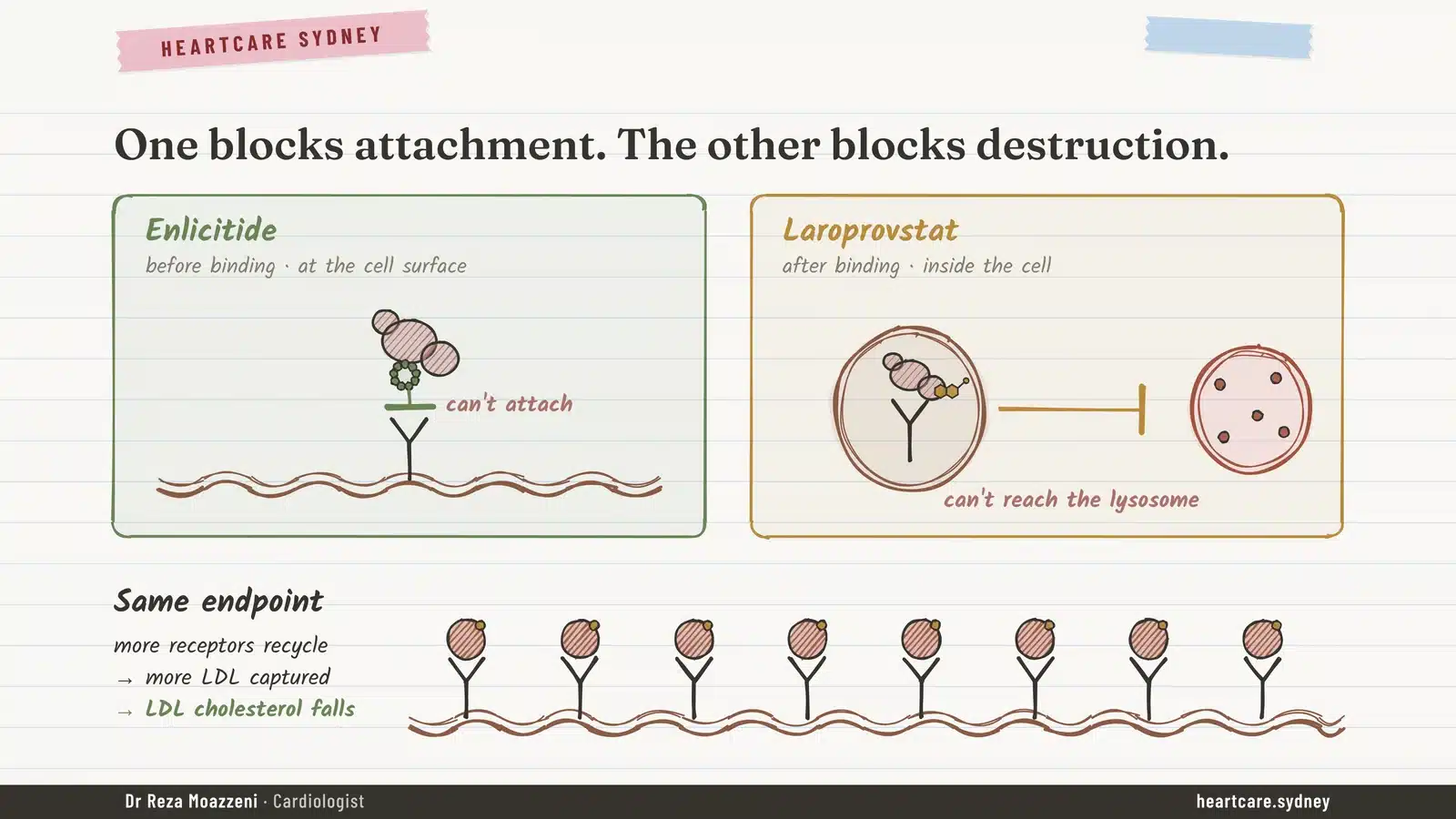
Enlicitide stops PCSK9 binding the LDL receptor. Laroprovstat lets PCSK9 bind, but stops it dragging the receptor to its destruction.
How they compare with the injections
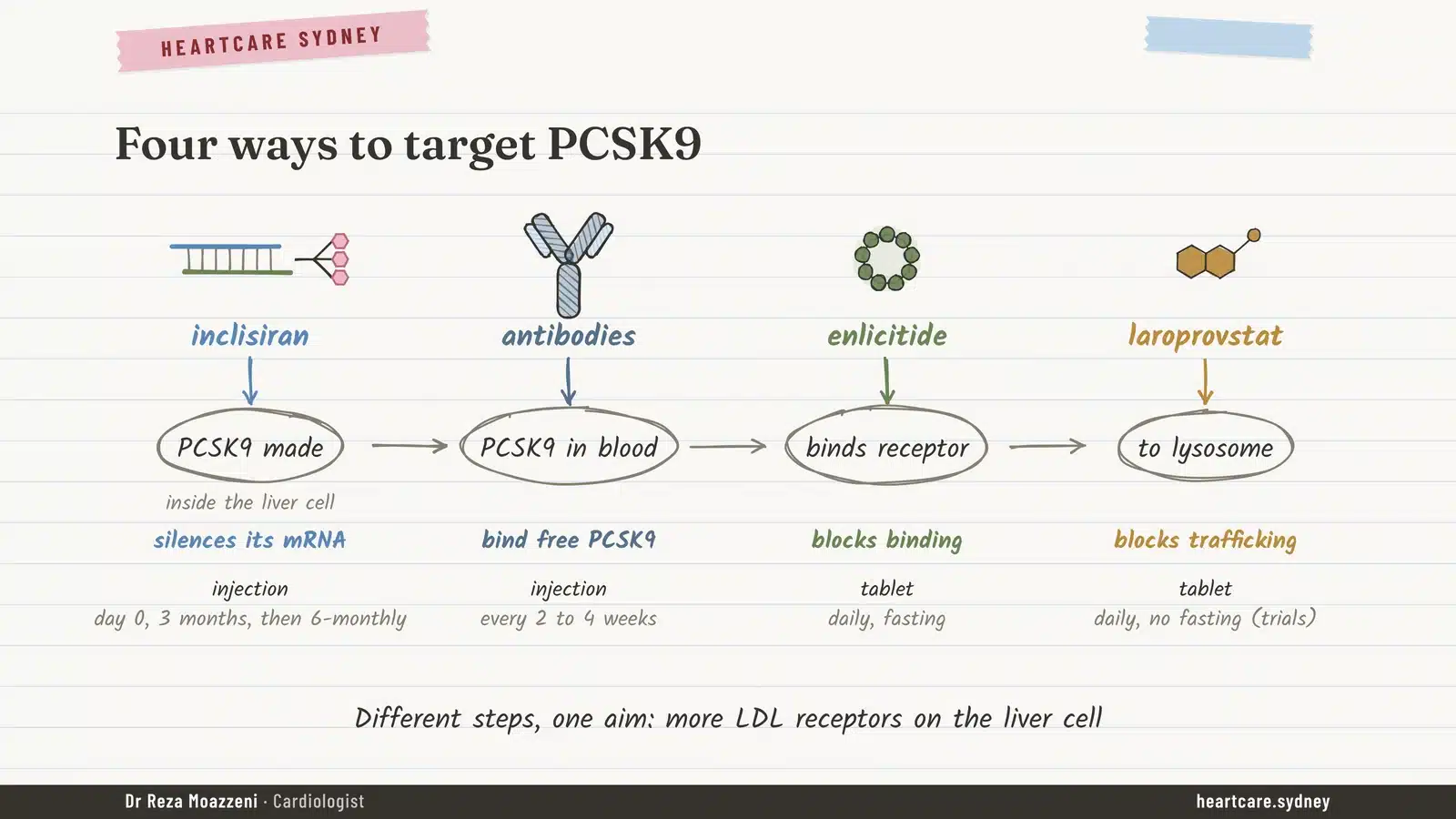
Australians already have injectable treatments that target PCSK9. Each acts at a different step:
- Inclisiran acts earliest. Inside the liver cell, it silences the instructions (messenger RNA) for making PCSK9, so less PCSK9 is made. It is given as an injection at the start, at 3 months, then every 6 months. See our guide to inclisiran.
- The antibodies (evolocumab, and alirocumab overseas) catch PCSK9 in the blood and stop it attaching to the receptor. They are injected every 2 to 4 weeks. Background on the class is in our article on PCSK9 inhibitors.
- Enlicitide blocks that same attachment, as a daily tablet.
- Laroprovstat acts last, after PCSK9 has bound, also as a daily tablet.
Four different steps, one shared aim: more LDL receptors working on the liver cell.
How much do they lower cholesterol?
In clinical trials, most participants were already taking a statin. Adding one of the new tablets lowered LDL cholesterol by roughly half compared with a dummy pill (placebo).
For enlicitide, the effect held up at one year (about 48% lower). In people with familial hypercholesterolaemia, an inherited cause of very high cholesterol, it lowered LDL by about 59%. Laroprovstat’s results come from a smaller, shorter, earlier-stage trial, so we will know more when its larger trials report.
These figures come from separate trials with different patients and lengths of follow-up. No trial has compared the two tablets with each other, or with the injections, so the numbers can’t be used to rank them.
- CORALreef Lipids (phase 3, n≈2,900, ASCVD or high risk, 97% on statin, baseline LDL-C ≈2.5 mmol/L): enlicitide 20 mg, −55.8% placebo-corrected at week 24; −47.6% at week 52 (Navar, NEJM 2026).
- CORALreef HeFH (n=303): −59.4% placebo-corrected at week 24 (Ballantyne, JAMA 2026).
- PURSUIT (phase 2b, n=428, on statin, baseline ≈2.6 mmol/L): laroprovstat 30 mg, −50.7% placebo-corrected at week 12 (Koren, JACC 2025).
- All sponsor-funded. No head-to-head data versus antibodies, inclisiran or each other.
How enlicitide is taken
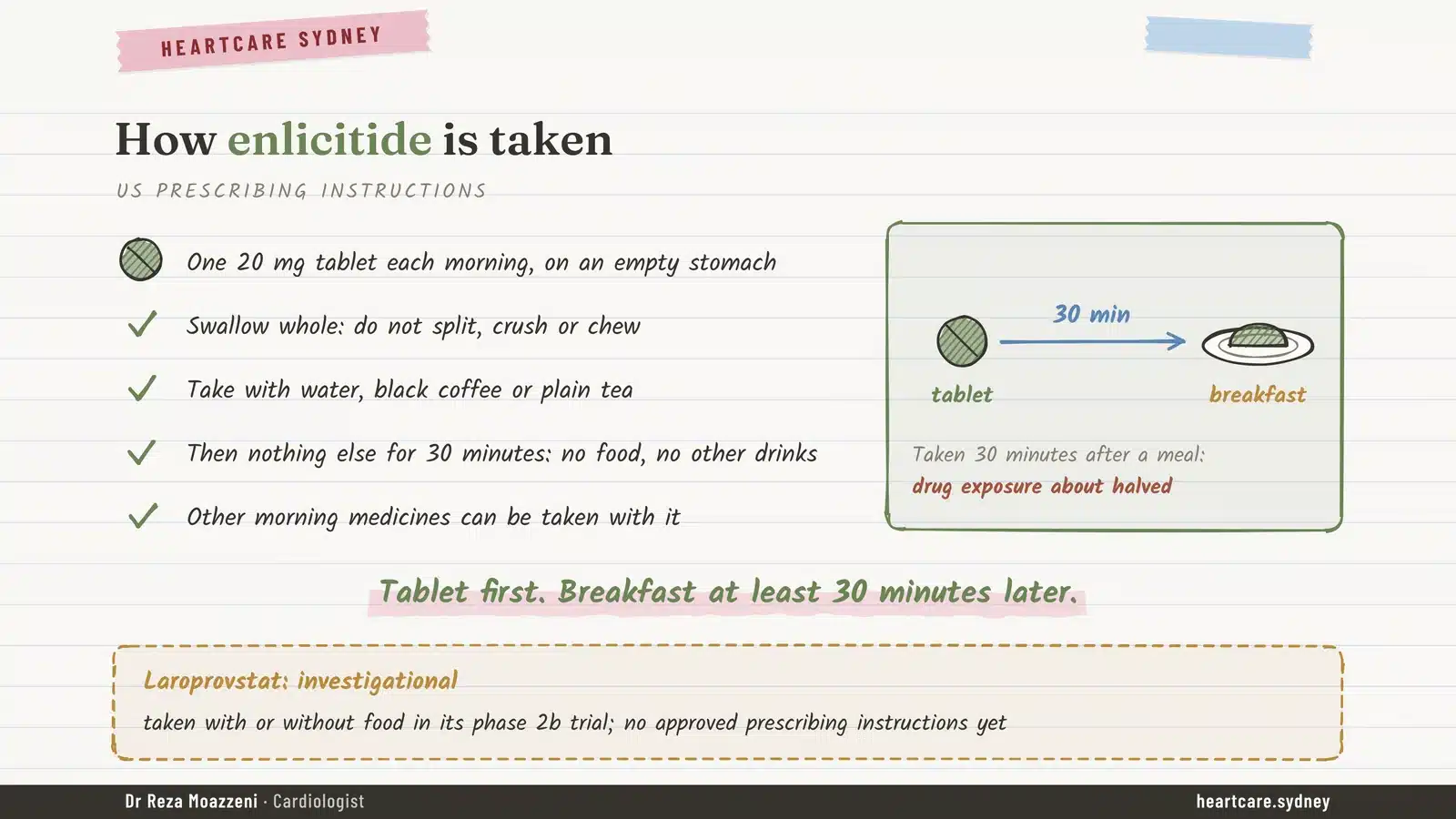
Because so little of each dose is absorbed, enlicitide has to be taken in a particular way. Under the US prescribing instructions:
- Take one 20 mg tablet each morning, on an empty stomach.
- Swallow it whole. Don’t split, crush or chew it.
- Take it with water, black coffee or plain tea.
- Then have nothing but water, black coffee or plain tea for at least 30 minutes.
- Other morning medicines can be taken at the same time.
This matters: taken half an hour after a meal, the amount of medicine in the blood roughly halves. The simplest rule is tablet first, breakfast at least 30 minutes later.
Laroprovstat is still being studied. In its phase 2b trial it was taken with or without food, but there are no approved instructions for it yet.
Can I get them in Australia?
Not yet. As of November 2026:
- Enlicitide was approved in the United States in July 2026 to lower LDL cholesterol in adults with high cholesterol, including familial hypercholesterolaemia. It is under review in Europe and Japan. It is not registered in Australia and is not on the PBS.
- Laroprovstat is not approved anywhere. The first results from its larger trials are expected in 2027.
In Australia today, the PBS-listed PCSK9 treatments are evolocumab and inclisiran, both injections, for people who meet the eligibility criteria. Alirocumab was discontinued by its sponsor here in 2024.
Enlicitide: FDA approval 15 July 2026 (NDA 220848), indication LDL-C lowering in adults with hypercholesterolaemia including HeFH; no cardiovascular outcomes claim. Under regulatory review in the EU and Japan (Merck Q3 2026). Not on the ARTG or PBS as of November 2026. Laroprovstat: phase 3 (AZURE-LDL, AZURE-HeFH); first phase 3 data expected H1 2027.
What we don’t know yet
This is the most important caveat. Neither tablet has yet been shown to prevent heart attacks or strokes. Lower LDL is very likely to help, because it has with every other way of lowering it, but each new medicine still has to prove it.
The PCSK9 antibody injections have done this. In two large trials, FOURIER and ODYSSEY OUTCOMES, they lowered the risk of major heart events by 15% in relative terms: about 1.5 fewer events for every 100 people treated over 2 to 3 years.
For the tablets, the answers will come from two very large trials, CORALreef Outcomes (more than 14,500 people) and AZURE-Outcomes (aiming for about 15,000). Both expect their main results in late 2029.
So far, side effects in trials have been broadly similar to placebo. Diarrhoea and dizziness were a little more common with enlicitide in the familial hypercholesterolaemia trial, and long-term safety data are still limited.
- PCSK9 lowers the number of LDL receptors on liver cells, so LDL cholesterol rises.
- Enlicitide stops PCSK9 attaching to the receptor. Laroprovstat lets it attach but blocks the route to the receptor’s destruction.
- Both lowered LDL cholesterol by about half in trials, on top of statins.
- Enlicitide must be taken each morning on an empty stomach, then nothing but water, black coffee or plain tea for 30 minutes.
- Neither is available in Australia yet, and neither has outcome data yet; results are expected around 2029.
How our clinic can help
New tablets are interesting, but for most people the right plan today still starts with a statin, often with ezetimibe, and, where needed, one of the PBS-listed injections. At our clinic we look at your full picture: your LDL level, family history, other risk factors and, where useful, a coronary calcium score or Lp(a) test. Then we work out the plan that gets your cholesterol where it needs to be.
If high cholesterol runs in your family, read our guide to familial hypercholesterolaemia. For a wider view of prevention, see how to prevent a heart attack, and our review of lipoprotein(a).
Worried about your cholesterol?
Dr Reza Moazzeni is a consultant cardiologist in Westmead and at Sydney Adventist Hospital. If your LDL remains high on a statin, or high cholesterol runs in your family, an assessment can help decide the next step. A GP referral is required.
Book an appointmentFrequently asked questions
What is an oral PCSK9 inhibitor?
It is a tablet that blocks PCSK9, a liver protein that reduces the number of LDL receptors. Keeping more receptors working helps the liver clear LDL cholesterol from the blood. Until now, PCSK9 treatments have only been available as injections in clinical use.
How is enlicitide different from laroprovstat?
Enlicitide stops PCSK9 attaching to the LDL receptor. Laroprovstat lets PCSK9 attach but stops it taking the receptor to the lysosome to be destroyed. Both end up keeping more receptors on the liver cell surface.
Are the tablets as good as the PCSK9 injections?
No trial has compared them directly, so we can’t say whether one works better than the other. The injections have also been shown to reduce heart attacks and strokes; the tablets have not yet.
Can I get enlicitide in Australia?
Not yet. As of November 2026 it is approved in the United States only, and it is not registered in Australia or listed on the PBS. Laroprovstat is not approved anywhere yet.
Should I stop my statin and wait for these tablets?
No. Statins have strong evidence for preventing heart attacks and strokes, and the new tablets were tested on top of statins, not instead of them. Don’t stop or change any cholesterol medicine without talking to your doctor first.
Main sources
- Navar et al., N Engl J Med 2026 (CORALreef Lipids).
- Ballantyne et al., JAMA 2026 (CORALreef HeFH).
- Koren et al., JACC 2025 (PURSUIT).
- Enlicitide US Prescribing Information, July 2026 (FDA NDA 220848).
- Sabatine et al., N Engl J Med 2017 (FOURIER); Schwartz et al., N Engl J Med 2018 (ODYSSEY OUTCOMES).
Figures come from published studies and the US prescribing information current in November 2026. The illustrations are schematic and show no real patient results. Please don’t start, stop or change any medicine without talking to your doctor.