
High blood pressure is the most common treatable cause of heart attack and stroke, and most people who have it are still not well controlled. In October 2026 the International Society of Hypertension (ISH) released new worldwide guidelines that lower the bar for acting, tighten how blood pressure should be measured, and make treatment simpler. Here is what has changed and what it means for you, whether you are a patient, a carer or a GP.
Why new guidelines, and why now?
We already know how to treat high blood pressure. The medicines are old, cheap and well studied. The trouble is putting that knowledge into practice. In Australia nearly two in five adults have high blood pressure, and only about 40% of them are on treatment with it below 140/90.
The reward for closing that gap is large. Across more than 100 trials, lowering the top (systolic) number by 10 mmHg cut major heart and blood vessel events by about a fifth, and strokes and heart failure by just over a quarter. These are relative reductions, so the people at highest risk gain the most.
The new guideline lists ten revisions. Five of them change everyday care:
- A new name, elevated blood pressure, for readings that used to be called “high-normal”.
- A proper, standard way of measuring, in the clinic and at home.
- Treatment for most people with confirmed elevated blood pressure, aiming below 130/80.
- Missed tablets are named as a risk factor in their own right.
- New options when blood pressure stays high on several medicines.
Each recommendation is marked either “Essential” (the minimum, for places with limited resources) or “Optimal” (the standard wherever resources allow, as in Australia). This article describes Optimal care.
The new blood pressure categories
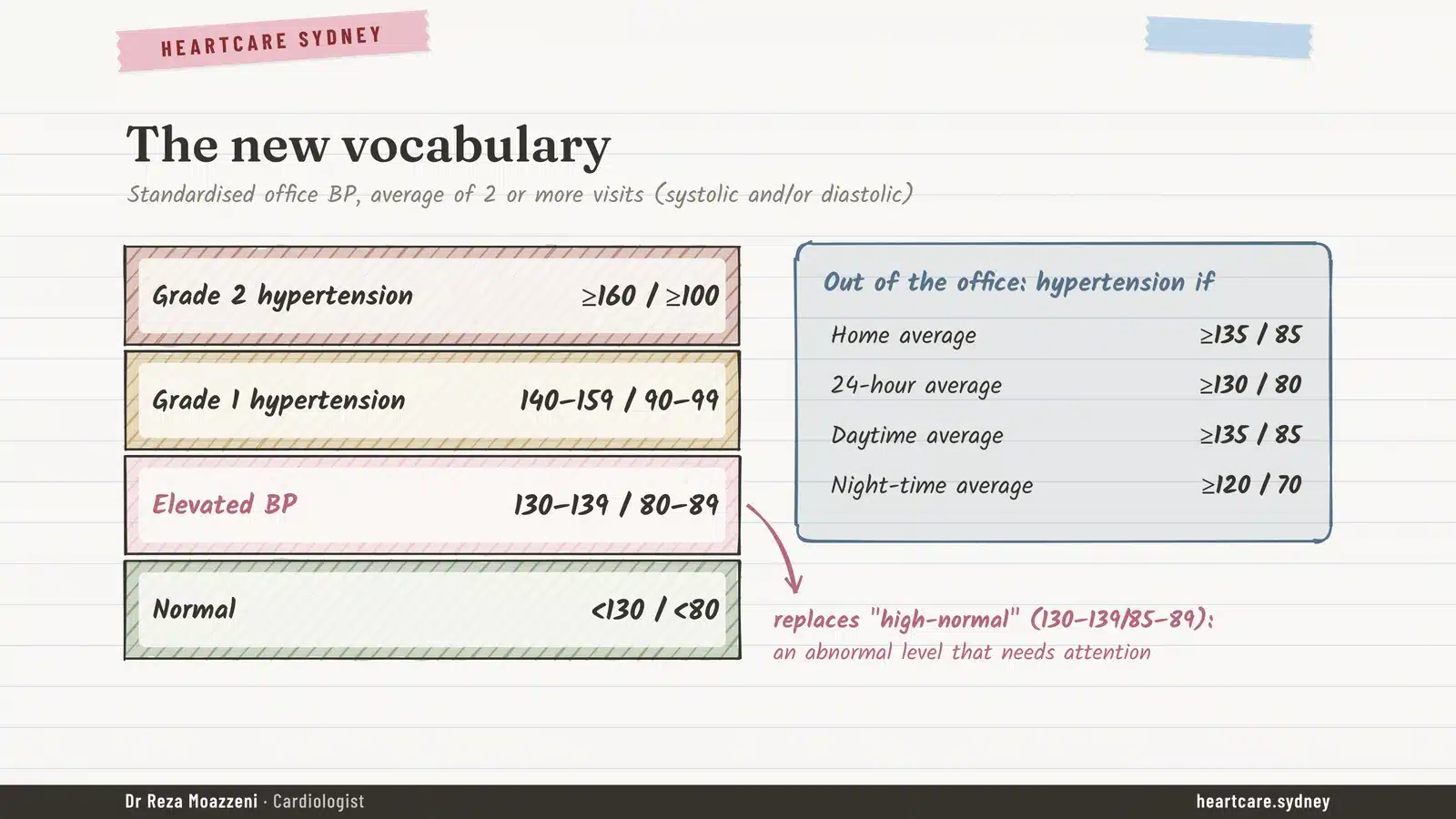
| Category | Clinic reading (mmHg) |
|---|---|
| Normal | Below 130/80 |
| Elevated blood pressure | 130–139 / 80–89 |
| Grade 1 hypertension | 140–159 / 90–99 |
| Grade 2 hypertension | 160/100 or higher |
The guideline calls 130–139/80–89 an abnormal level that deserves attention. It replaces the old “high-normal” band, and the cut-off for the lower number has dropped from 85 to 80.
Readings taken outside the clinic run lower, so the cut-offs are lower too. High blood pressure at home is an average of 135/85 or more. On a 24-hour monitor it is an average of 130/80 or more, and 120/70 or more during sleep.
Measuring it properly
The guideline is blunt about this: a quick, casual reading is not good enough to diagnose high blood pressure or to adjust treatment.
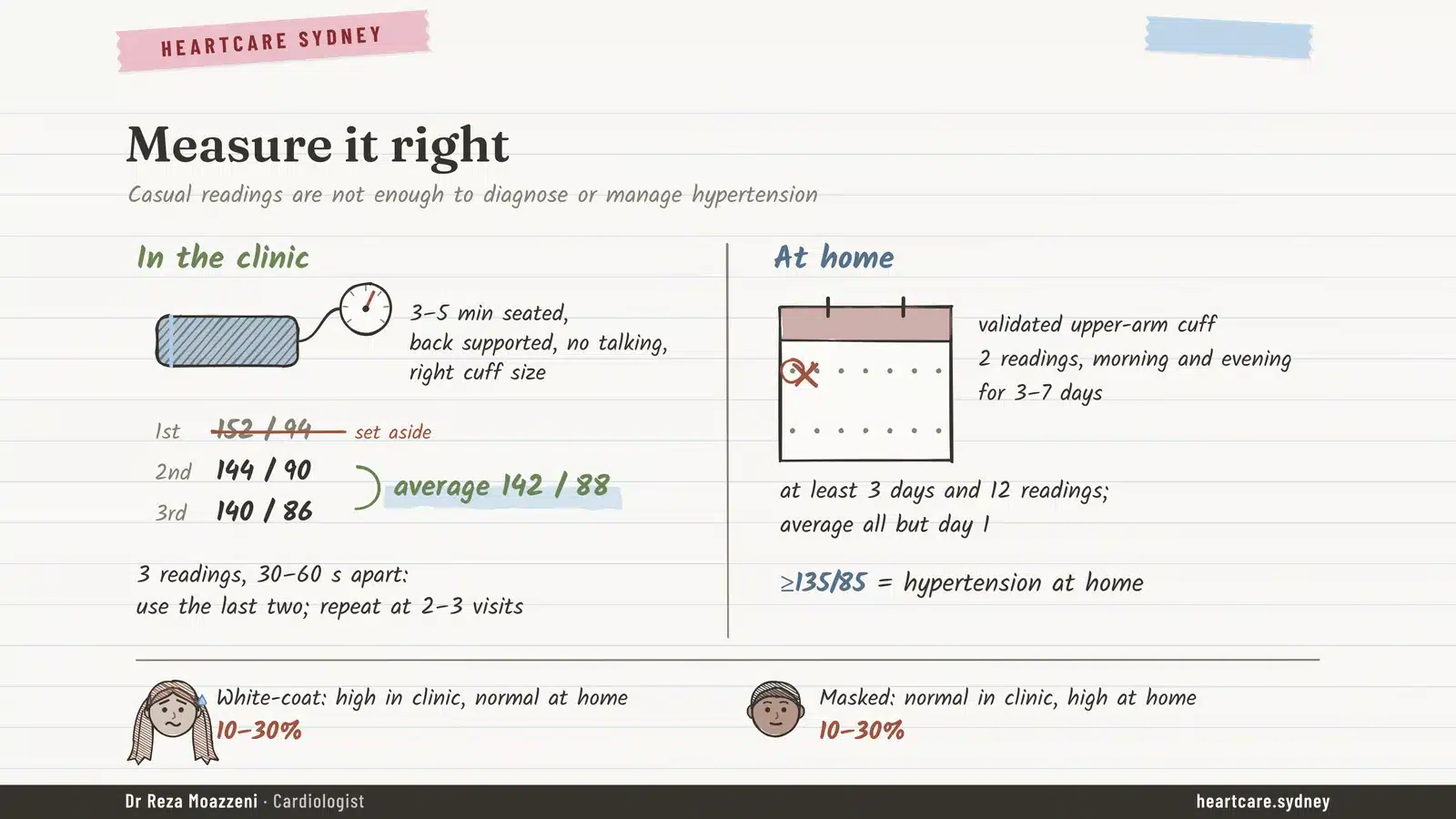
In the clinic
- Sit quietly for 3 to 5 minutes first, back supported, no talking.
- Use a cuff that fits the arm.
- Take three readings, 30 to 60 seconds apart, and average the last two.
- Repeat over two or three visits before deciding.
At home
- Use a validated upper-arm monitor (not a wrist device).
- Take two readings in the morning and two in the evening, for 3 to 7 days.
- You need at least 12 readings. Leave out the first day and average the rest.
Home monitoring is now the main method in Optimal care. It is more repeatable, and it catches two common traps. “White-coat” hypertension is high in the clinic but normal at home. “Masked” hypertension is the reverse. Each affects 10 to 30% of people seen in clinics.
Who needs treatment, and what is the target?
- 140/90 or higher, confirmed: most people start with two medicines combined in a single pill.
- Elevated blood pressure (130–139/80–89): treatment usually starts with one medicine.
- Start straight away if you have heart or blood vessel disease, chronic kidney disease, diabetes, signs of organ damage from blood pressure, readings of 160/100 or more, or a moderate to high overall risk.
- Otherwise, try three months of lifestyle change first: less salt and alcohol, more activity, and weight loss where needed.
The target is below 130/80, in the clinic and at home, reached within three months, with a check each month until you get there.
For people over 85, or with frailty, dizziness on standing or a limited life expectancy, the target and the pace are tailored to the person.
Why two medicines from the start?
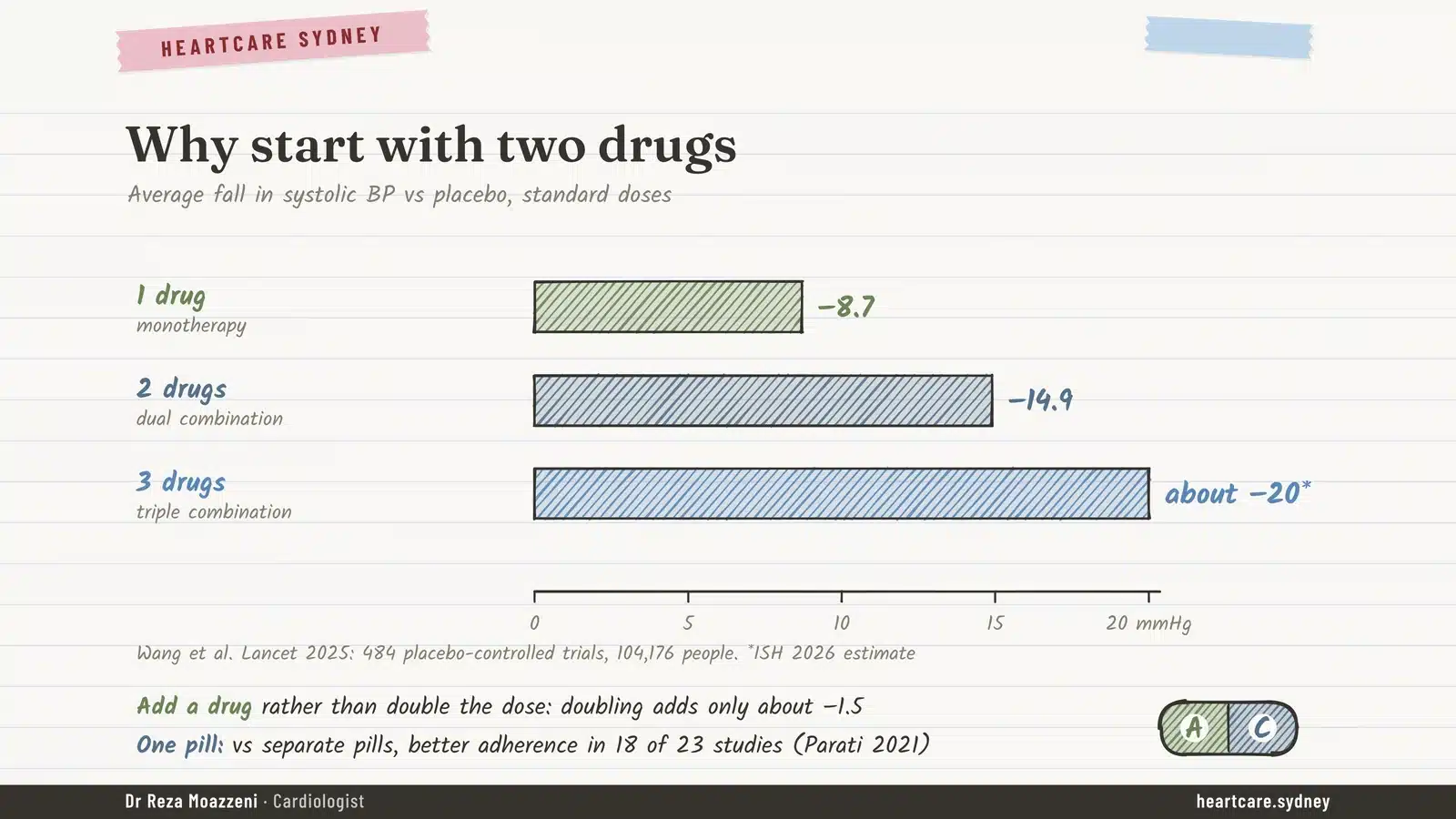
Many people are surprised to be started on a “combination” pill. The reasoning is simple. In a 2025 analysis of placebo-controlled trials, one medicine at a standard dose lowered the top number by about 9 mmHg. Two medicines lowered it by about 15, and the guideline puts three at about 20. Doubling the dose of a single medicine added only about 1.5.
One pill is also easier to remember than two. In 18 of 23 studies, people took their treatment more reliably when the medicines came as a single pill than as the same medicines in separate pills.
The medicines, class by class
The guideline uses letters as shorthand for the main groups of blood pressure medicines.
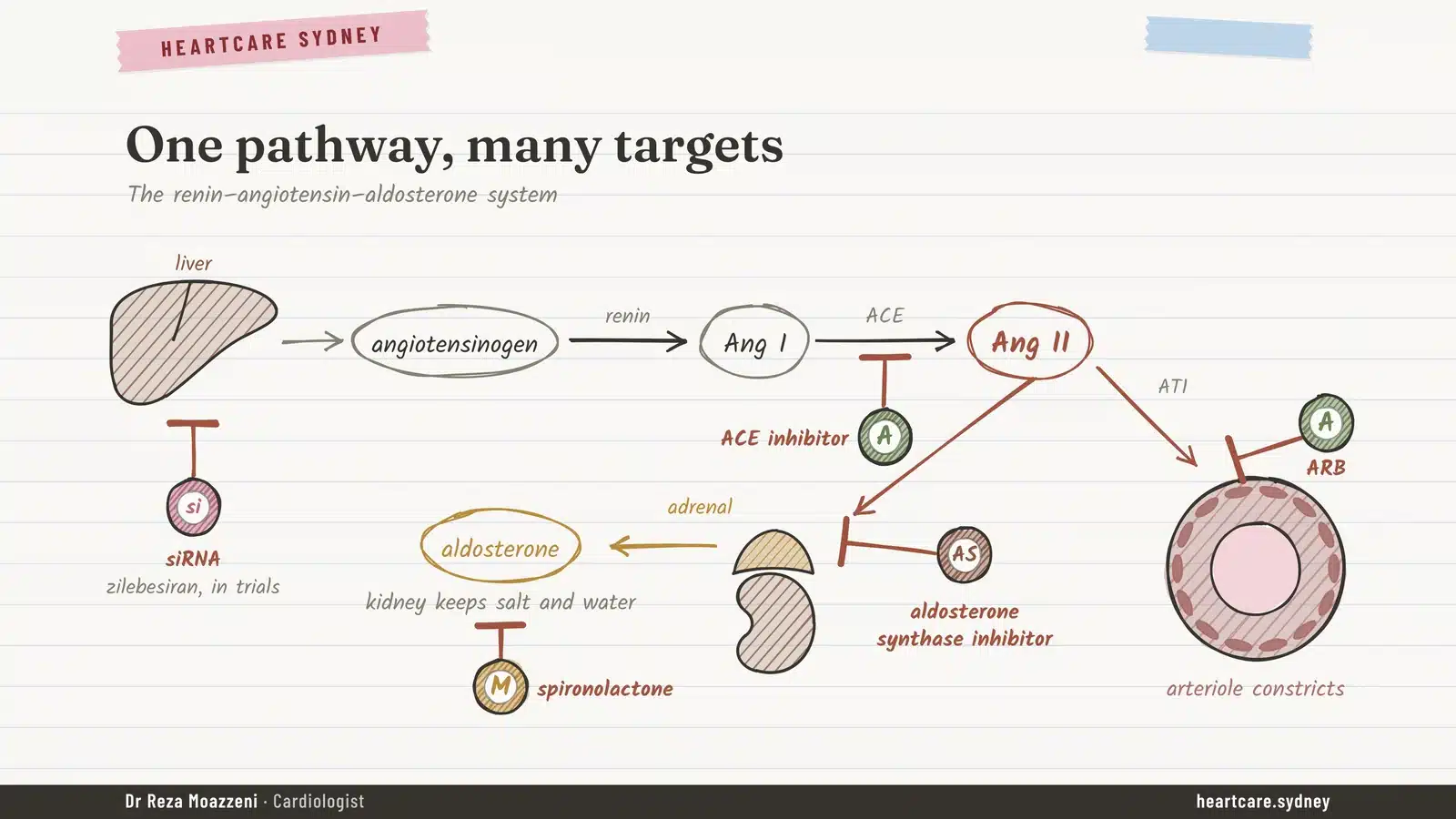
- A: ACE inhibitors and ARBs. They block a hormone called angiotensin II, so the small arteries relax. You take one or the other, never both.
- C: calcium channel blockers. They relax the muscle in the artery wall so the artery widens. Ankle swelling is the most common side effect, and it is more likely at higher doses.
- D: thiazide-type diuretics (such as chlortalidone or indapamide). They help the kidneys pass a little more salt.
- M: spironolactone. It blocks aldosterone, the salt-retaining hormone. It is the preferred fourth medicine.
- B: beta-blockers. They are added at any stage when there is a specific reason, such as heart failure, angina, a previous heart attack or atrial fibrillation.
- ACE inhibitor or ARB: check potassium and creatinine 2 to 4 weeks after starting or titrating. A small early fall in eGFR is expected; consider stopping if it falls by more than 30%. Avoid both in pregnancy. Full doses are preferred in heart failure, CKD and coronary disease.
- When eGFR is below 30, a loop diuretic or chlortalidone is preferred.
- Spironolactone: use when potassium is below 4.5 mmol/L and eGFR is 30 or more, with close monitoring.
- Beta-blockers also have a place in pregnancy or when planning one, where labetalol is a first choice.
The step-by-step pathway
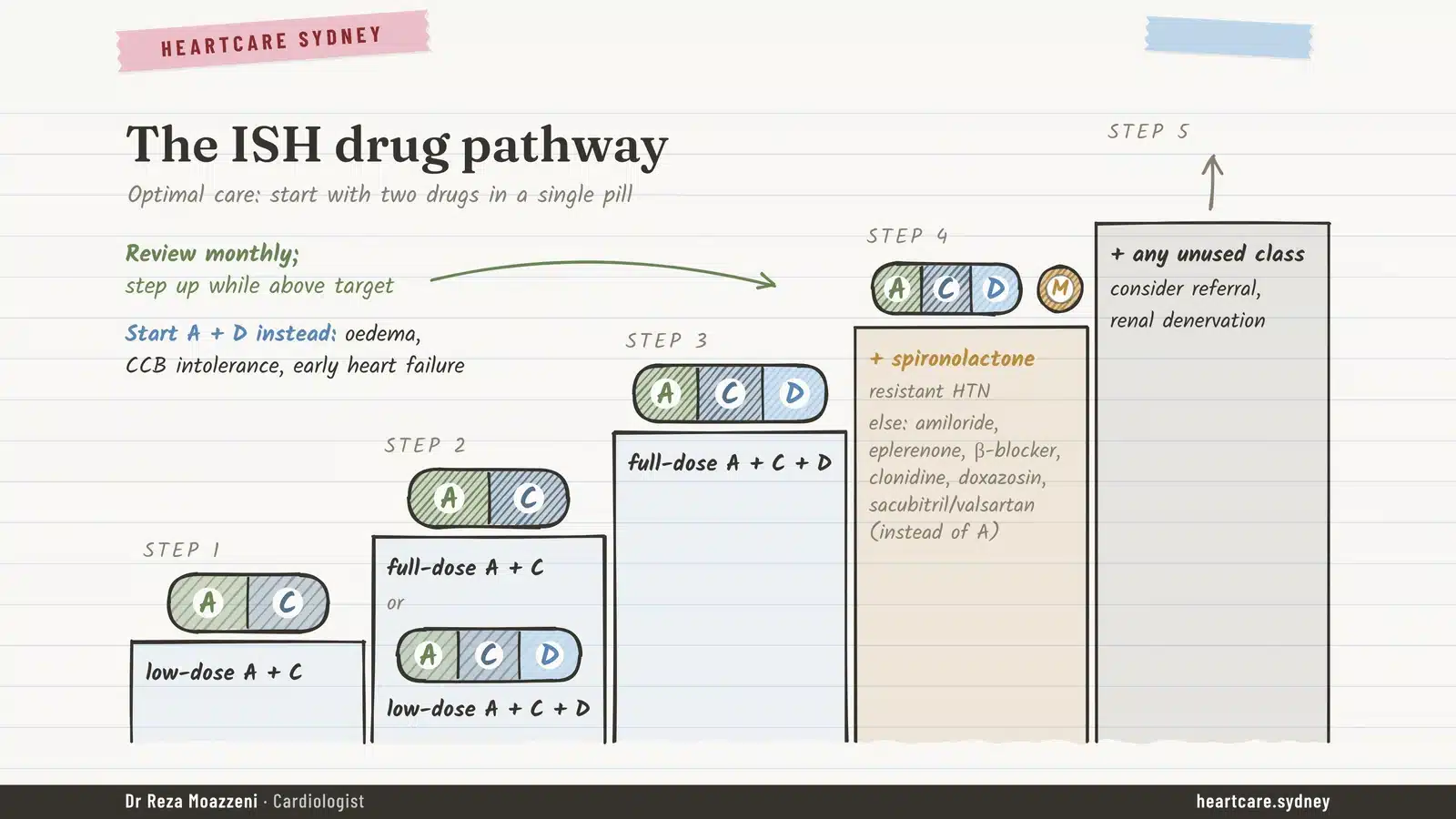
- Step 1: a low dose of A plus C in one pill.
- Step 2: full doses of both, or a low-dose pill with all three (A, C and D).
- Step 3: the three-medicine pill at full dose.
- Step 4: add spironolactone. Blood pressure that is still high at this point is called “resistant”.
- Step 5: add a class not yet used, and consider referral to a specialist centre.
A plus D may be the starting pair instead when there is ankle swelling, when a calcium channel blocker is not tolerated, or in early heart failure.
- If spironolactone is not tolerated, ISH lists amiloride, eplerenone, a beta-blocker, clonidine, doxazosin, or sacubitril/valsartan in place of the ACE inhibitor or ARB. In Australia sacubitril/valsartan is approved only for heart failure with reduced ejection fraction.
- Prazosin and moxonidine are not named. Doxazosin is the once-daily alpha-blocker, and moxonidine should be avoided in heart failure.
- Since 1 April 2026, dual-therapy fixed-dose combinations can be prescribed first line on the PBS.
When blood pressure stays high
Before anyone is labelled “resistant”, the guideline asks for a careful check, because about half of apparent cases turn out to be something else:
- The readings were not taken in the standard way.
- It is a white-coat effect, so home or 24-hour readings are needed.
- Tablets are being missed. This affects 30 to 50% of people on treatment, and it is nothing to be embarrassed about. Tell us, because it changes what we do next.
- Something else is pushing it up: anti-inflammatory painkillers, decongestants and liquorice are common culprits.
Next comes a search for an underlying cause. The most important is primary aldosteronism, an overactive adrenal gland, found in up to one in five people with resistant hypertension.
For those who truly need more, there are new options after spironolactone. Baxdrostat, which stops aldosterone being made, lowered the top number by 9 to 10 mmHg more than placebo at 12 weeks. Aprocitentan, which works on a different pathway, lowered it by about 4 mmHg more than placebo at 4 weeks; it can cause fluid retention and must not be used in pregnancy. Renal denervation, a catheter procedure on the nerves around the kidney arteries, lowers blood pressure by about as much as one effective medicine, in most but not all patients. None of the new medicines has yet been shown to prevent heart attacks or strokes, and access in Australia is still limited.
In the baxdrostat trial, potassium above 6 mmol/L occurred in 2 to 3%. Baxdrostat is approved in the US and under evaluation by the TGA. Aprocitentan is not registered in Australia, and there is no MBS item for renal denervation.
How does this compare with Europe and the United States?
The three big guidelines now agree on the essentials: confirm with readings outside the clinic, and start most people who are at 140/90 or above on two medicines, ideally in one pill. They differ in the detail.
| Point | ISH 2026 | European (ESC 2024) | American (ACC/AHA 2025) |
|---|---|---|---|
| 130–139/80–89 is called | Elevated BP | Elevated BP (their band starts at 120/70) | Stage 1 hypertension |
| Medicines at that level | Most people (Optimal care) | If risk is high, after 3 months of lifestyle change | If heart disease, diabetes, kidney disease or raised risk; otherwise after 3 to 6 months |
| Target | Below 130/80 within 3 months | Top number 120–129 if tolerated | Below 130/80; below 120 encouraged if risk is increased |
| First pair | A plus C | A plus C, or A plus D | Two of A, C and D |
In Australia, the 2016 Heart Foundation guideline still applies while a new one is in draft.
Home monitoring made easier: Health Diary
Because home readings now sit at the centre of care, our clinic built Health Diary, a free online blood pressure diary. There is nothing to install.
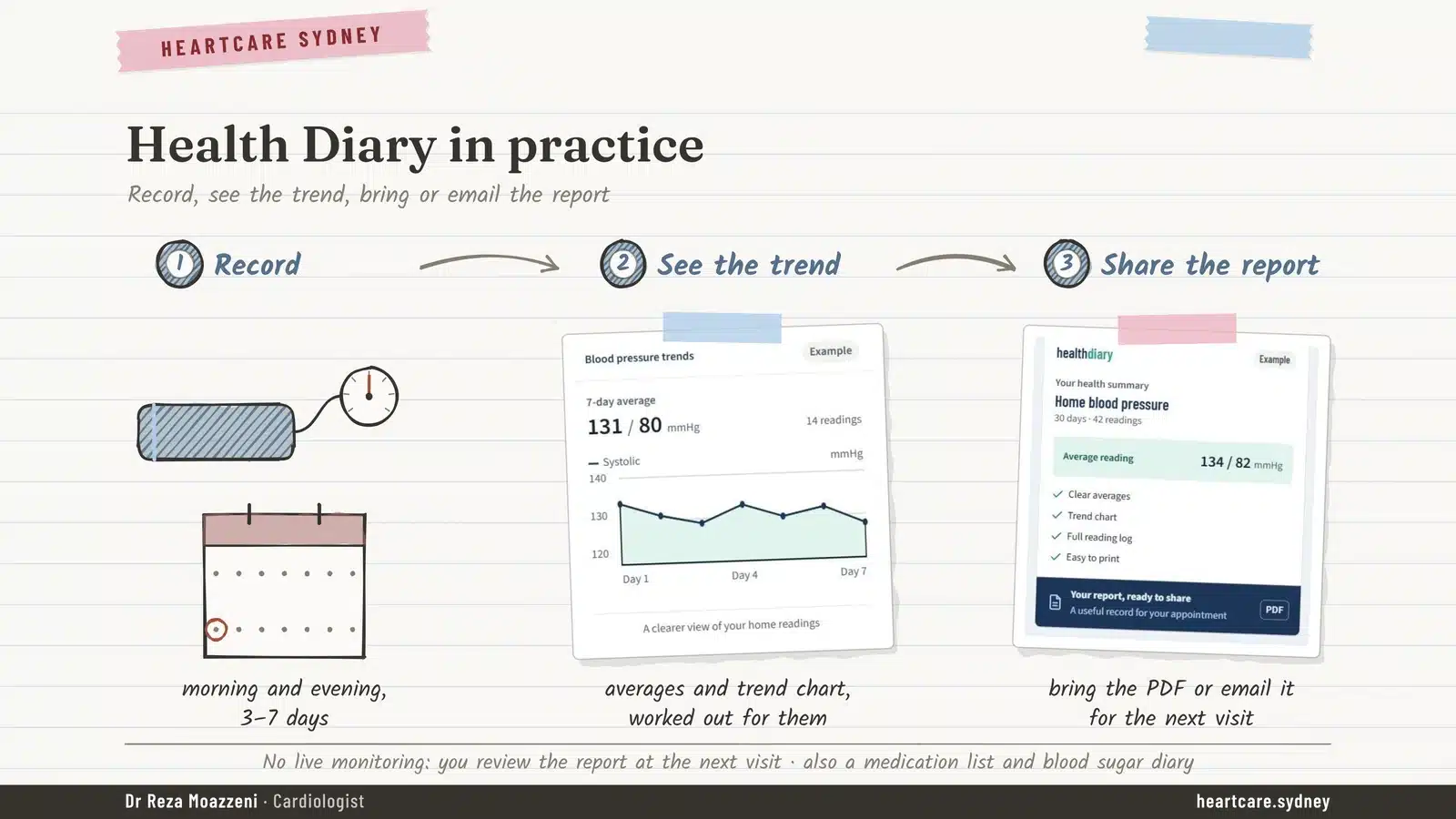
- Enter a reading on your phone in a few taps, or take a photo of the monitor and the app reads the numbers for you.
- It works out your averages and draws a trend chart. The seven-day average shows how many readings and days it covers.
- Before your appointment, bring the PDF report or email it. It shows your averages, morning and evening readings, how often you were below target, and the full log.
- Only you can see your readings, and they are stored in Australia.
- It also keeps a medication list and a blood sugar diary.
There is no live monitoring. Nobody is watching your readings between visits, so if you feel unwell or your readings are very high, contact your doctor, or call 000 in an emergency.
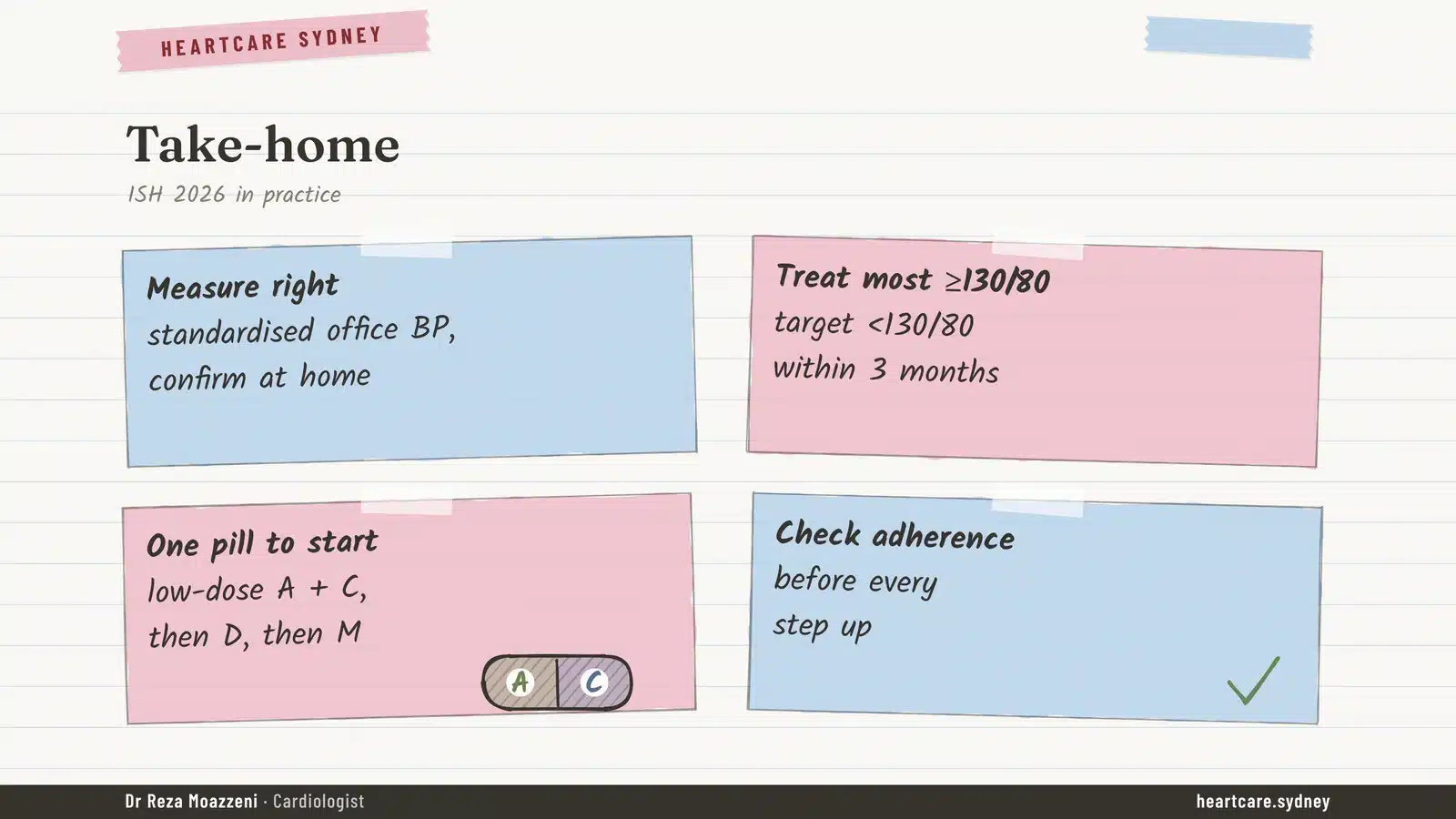
- 130–139/80–89 is now called elevated blood pressure, and it is not normal.
- Diagnosis rests on careful readings, confirmed at home: at least 12 readings over 3 to 7 days.
- The target for most people is below 130/80, within three months.
- From 140/90, treatment usually starts with two medicines in one pill.
- If blood pressure stays high, check the measurement and the tablets before adding more.
How our clinic can help
At Heartcare Sydney we see people whose blood pressure is hard to control, whose readings differ between home and clinic, or who have side effects from their medicines. We can arrange 24-hour blood pressure monitoring, look for underlying causes such as primary aldosteronism, check the heart for strain with an echocardiogram, and work out a plan with you and your GP. We consult at Westmead and at Sydney Adventist Hospital, in English and Persian (Farsi).
Blood pressure is one part of the bigger picture. For the other steps that lower your risk, see how to prevent a heart attack.
Worried about your blood pressure?
If your blood pressure is hard to get to target, your home and clinic readings don’t match, or your medicines are causing side effects, an assessment can help work out the next step.
Book an appointmentFrequently asked questions
What is “elevated blood pressure”?
It is a clinic reading of 130–139 over 80–89, measured properly on more than one visit. The 2026 guideline treats it as an abnormal level that needs attention, starting with lifestyle change and, for most people, medication if it stays there.
What should my blood pressure be?
For most adults on treatment the target is below 130/80, both in the clinic and at home. The target is adjusted for people over 85 and for those who are frail or get dizzy on standing. Your own doctor will set the right number for you.
Why have I been started on a pill with two medicines in it?
Two medicines at low dose lower blood pressure more than one medicine at a higher dose: about 15 mmHg compared with about 9. A single pill is also easier to take reliably. This is now the recommended start for most people at 140/90 or above.
How should I measure my blood pressure at home?
Use a validated upper-arm monitor. Sit quietly for a few minutes, then take two readings in the morning and two in the evening for 3 to 7 days. Leave out the first day and average the rest. You need at least 12 readings. An average of 135/85 or more counts as high.
My blood pressure is still high on three medicines. What happens next?
First we check that the readings are accurate, that it is not a white-coat effect, that the tablets are being taken, and that nothing else is raising it. Then we look for an underlying cause such as primary aldosteronism. If it is truly resistant, spironolactone is usually the next medicine, and a specialist review is worthwhile.
Main sources
- 2026 International Society of Hypertension Global Hypertension Practice Guidelines, J Hypertens (October 2026).
- 2024 ESC Guidelines for the management of elevated blood pressure and hypertension (August 2024).
- 2025 AHA/ACC guideline for the management of high blood pressure in adults (August 2025).
- World Health Organization, Global report on hypertension (2025).
- Australian Institute of Health and Welfare, Hypertension in Australia (May 2026).
This article is general information, not personal medical advice. Do not start, stop or change a medicine without talking to your own doctor. The illustrations are schematic. Information current at November 2026.