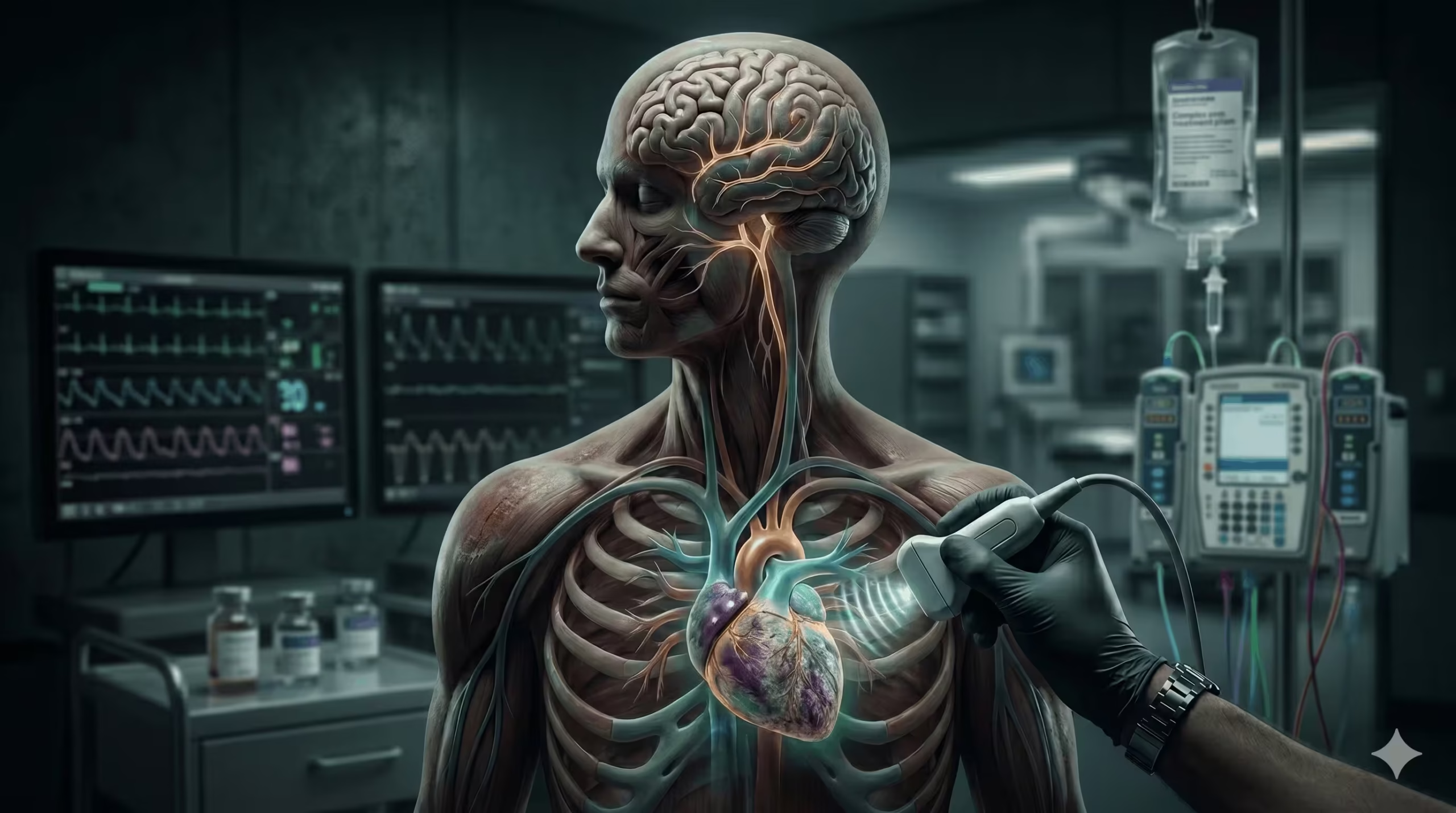
Modern cancer therapies have transformed survival — but several classes of chemotherapy, targeted agents, and immunotherapies can injure the heart. Cardio-oncology is the clinical field focused on preventing, detecting, and managing heart problems related to cancer treatment, and echocardiography is its primary imaging tool. Echo is used to stratify cardiac risk before treatment starts, detect cardiotoxicity early while it is still reversible, and guide long-term surveillance in cancer survivors.
What This Page Covers
In plain terms, this page answers four questions:
- Who needs a baseline echocardiogram before cancer therapy?
- Which cancer treatments can damage the heart?
- How do we detect cardiac injury early — before symptoms develop?
- What happens if an abnormality is found?
When Is Cardiac Imaging Needed?
Cardiac imaging in cancer patients serves three distinct purposes, each tied to a different phase of the cancer journey.
Baseline risk stratification
Establish baseline LV function, valvular status, and pericardial appearance before cardiotoxic therapy begins. Paired with the HFA-ICOS risk score to set the monitoring schedule.
Surveillance for early injury
Detect subclinical dysfunction using LVEF, GLS, and cardiac biomarkers — before symptoms develop. Frequency is tailored to drug class, cumulative dose, and baseline risk.
Late-effect detection
Cardiotoxicity can present months to decades later. Survivors of anthracyclines, trastuzumab, and chest radiation need ongoing surveillance.
Who Needs a Baseline Echocardiogram?
The 2022 ESC Cardio-Oncology Guidelines recommend a baseline echocardiogram for any patient starting therapy with meaningful cardiotoxic potential, or with pre-existing factors that amplify cardiac risk.
Patients who benefit most from baseline echocardiography:
- Those starting anthracyclines (doxorubicin, epirubicin, daunorubicin)
- Those starting HER2-targeted therapy (trastuzumab, pertuzumab)
- Pre-existing cardiovascular disease or heart failure
- Age over 65 at start of treatment
- Hypertension, diabetes, or established coronary artery disease
- Planned mediastinal or left-sided chest radiation
- Previous exposure to cardiotoxic therapy
- Childhood cancer survivors receiving further cancer treatment
Cancer Therapies That Can Harm the Heart
Not every cancer drug is cardiotoxic, and the pattern of injury varies by class. Surveillance strategy is tailored to the specific agent, cumulative dose, and baseline patient risk.
| Drug class | Examples | Main cardiac effect | Echo approach |
|---|---|---|---|
| Anthracyclines | Doxorubicin, epirubicin, daunorubicin | Dose-dependent dilated cardiomyopathy; often irreversible | Baseline + at cumulative dose thresholds + end of therapy + 12 months |
| HER2-targeted therapy | Trastuzumab, pertuzumab | Reversible LV dysfunction; worse when combined with anthracyclines | Baseline + every 3 months during therapy |
| VEGF / tyrosine kinase inhibitors | Sunitinib, sorafenib, bevacizumab, pazopanib | Hypertension, LV dysfunction, QT prolongation | Baseline + BP surveillance; echo if symptoms or worsening HTN |
| Immune checkpoint inhibitors | Pembrolizumab, nivolumab, ipilimumab | Rare but severe myocarditis, often fulminant | Baseline; urgent echo ± cardiac MRI if symptomatic |
| Alkylating agents | Cyclophosphamide (high-dose), ifosfamide | Acute HF, pericardial effusion, myocarditis | Baseline + if symptomatic |
| Proteasome inhibitors | Bortezomib, carfilzomib | Heart failure, hypertension | Baseline + periodic during therapy |
| BCR-ABL TKIs | Nilotinib, ponatinib | Vascular events, heart failure | Baseline + cardiovascular risk review |
| CAR-T cell therapy | Tisagenlecleucel, axicabtagene ciloleucel | Arrhythmias, hypotension, stress cardiomyopathy | Baseline + during cytokine release syndrome |
| Radiation therapy | Mediastinal or left-chest fields | Valvular disease, pericardial disease, coronary atherosclerosis, restrictive cardiomyopathy | Baseline + long-term late-effect surveillance |
What an Echocardiogram Can Show in Cancer Patients
Echocardiography captures the full spectrum of cancer therapy-related cardiac injury across six main categories.
Cancer therapy-related cardiac dysfunction (CTRCD)
The dominant concern. Defined by LVEF and/or GLS decline, graded from mild to very severe.
Immune-mediated myocarditis
Especially with checkpoint inhibitors. Rare but carries high mortality; requires urgent imaging.
Pericardial disease
Effusion, tamponade physiology, or late constrictive pericarditis — particularly after radiation and high-dose cyclophosphamide.
Valvular disease
Typically post-radiation, developing years to decades after treatment. Progressive, often combined with other radiation injury.
Structural substrate for arrhythmias
Echo excludes alternative structural causes when atrial fibrillation, ventricular arrhythmias, or conduction disease arise during therapy.
Pulmonary hypertension
Uncommon but recognised, particularly with some TKIs. Echo is the screening tool.
Baseline Assessment Before Chemotherapy
Before starting potentially cardiotoxic therapy, the baseline echocardiogram establishes several reference points against which later scans are compared:
- LV ejection fraction — ideally by 3D volumetric or biplane method
- Global longitudinal strain (GLS) — the most sensitive marker of early dysfunction
- LV dimensions, wall thickness, and mass
- Baseline valvular status — critical when radiation is planned, for later comparison
- Right ventricular function
- Pericardial assessment
The baseline scan is paired with the HFA-ICOS risk score to set a monitoring schedule proportional to the patient's risk. Low-risk patients may need only periodic checks; high-risk patients require close surveillance throughout therapy. Heartcare Sydney performs baseline and surveillance echocardiograms for cancer patients at our Westmead echocardiogram service, with comparison to prior imaging where available.
Monitoring During Treatment
Surveillance frequency depends on the agent, cumulative dose, and baseline risk. Two principles hold across regimens.
Why LVEF Alone Is Not Enough
By the time LVEF falls into an abnormal range, meaningful myocardial injury has usually already occurred and full recovery becomes less certain. Modern surveillance protocols therefore combine LVEF with GLS and cardiac biomarkers — high-sensitivity troponin and NT-proBNP — to detect dysfunction at its earliest stage, when intervention is most effective.
Symptoms That Should Prompt Urgent Echo
Surveillance is not purely scheduled — it is symptom-triggered too. Any of the following during cancer therapy warrants urgent echocardiography regardless of the planned interval:
- New or worsening shortness of breath
- Leg swelling or weight gain suggesting fluid retention
- Palpitations or new arrhythmia
- Chest pain
- Syncope or near-syncope
The Role of Global Longitudinal Strain
Global longitudinal strain (GLS) measures the percentage shortening of myocardial fibres along the long axis of the left ventricle. Normal GLS is more negative than −18%. By convention GLS is expressed as a negative number, and a less-negative value indicates worse function.
- Detects myocardial dysfunction before LVEF changes
- A ≥15% relative reduction in GLS from baseline is clinically significant
- Enables earlier cardioprotective therapy, often preserving LV function
- Reproducible between studies when performed on the same vendor's equipment
The SUCCOUR trial (2020) compared GLS-guided cardioprotective therapy with LVEF-guided therapy in patients receiving anthracyclines or trastuzumab. GLS-guided care produced better preservation of ejection fraction, establishing GLS as a standard imaging endpoint in modern cardio-oncology surveillance. For technical detail on GLS and LVEF methodology, see our echocardiography reference hub.
Defining Cardiotoxicity: The CTRCD Framework
The 2022 ESC Cardio-Oncology Guidelines replaced older binary definitions with a graded framework — Cancer Therapy-Related Cardiac Dysfunction (CTRCD). It separates symptomatic from asymptomatic disease and grades severity, ensuring a consistent language between the oncologist, cardiologist, and imaging physician.
| Category | Severity | Defining findings |
|---|---|---|
| Asymptomatic | Mild | LVEF ≥50% with new GLS reduction >15% from baseline, or new rise in cardiac biomarkers |
| Asymptomatic | Moderate | New LVEF 40–49% — by absolute drop ≥10% from baseline, or with accompanying GLS or biomarker change |
| Asymptomatic | Severe | New LVEF <40% |
| Symptomatic | Mild | New heart failure symptoms, no treatment escalation required |
| Symptomatic | Moderate | Outpatient intensification of HF therapy required |
| Symptomatic | Severe / Very Severe | Hospitalisation, inotropic support, or mechanical circulatory support required |
What Happens If Cardiotoxicity Is Detected?
A change on echo does not automatically mean cancer treatment must stop. The decision is multidisciplinary — balancing cancer prognosis against cardiac risk — and the echo findings inform three possible paths:
- Initiate cardioprotective therapy. ACE inhibitors or ARBs, beta-blockers, and in selected patients SGLT2 inhibitors. Early initiation improves recovery of LVEF.
- Modify cancer therapy. Dose reduction, switch to a less cardiotoxic agent, or temporary interruption.
- Continue with closer surveillance. Appropriate in mild asymptomatic CTRCD where cancer control is critical and cardiac risk is acceptable.
Long-Term Follow-Up in Cancer Survivors
Cardiotoxicity can present years or even decades after the original cancer therapy. Childhood cancer survivors, patients exposed to high cumulative anthracycline doses, and those who received mediastinal radiation carry the highest late risk.
- Echocardiogram at completion of therapy
- Repeat echo at 6–12 months post-completion
- Periodic follow-up thereafter — interval set by risk profile
- Lifelong surveillance in high-risk survivors (high cumulative anthracycline dose, chest radiation, symptomatic CTRCD during therapy)
- Parallel cardiovascular risk-factor management (blood pressure, lipids, diabetes, smoking) remains central
- Modern cancer therapy is highly effective, but several classes — anthracyclines, HER2-targeted agents, checkpoint inhibitors, some TKIs, and chest radiation — can damage the heart.
- Echocardiography is the primary imaging tool for baseline risk stratification, surveillance during treatment, and long-term survivor follow-up.
- Global longitudinal strain detects cardiotoxicity earlier than LVEF; a ≥15% relative reduction from baseline is significant.
- The 2022 ESC Cardio-Oncology Guidelines introduced the graded CTRCD framework, now the standard language across disciplines.
- Early detection enables cardioprotective therapy and often preserves cardiac function.
- Late cardiotoxicity is well recognised — surveillance continues after cancer therapy ends, particularly in anthracycline- and radiation-exposed survivors.
Frequently Asked Questions
Why do I need an echocardiogram before starting chemotherapy?
To establish a baseline of heart function that future scans can be compared against, and to identify any pre-existing heart problem that may change the choice of cancer therapy or require treatment before chemotherapy begins.
What is global longitudinal strain (GLS) and why does it matter?
GLS measures how well the heart muscle shortens with each beat. It detects subtle dysfunction earlier than ejection fraction, allowing cardioprotective treatment to begin while the heart's pump function is still preserved.
Does a drop in heart function mean I have to stop chemotherapy?
Not automatically. The decision is shared between the oncologist and cardiologist, balancing cancer prognosis against cardiac risk. Many patients continue therapy with added cardioprotective medication or a dose adjustment rather than stopping treatment entirely.
Can the heart recover after chemotherapy-induced cardiotoxicity?
Often, particularly with trastuzumab-related dysfunction and when detected early. Anthracycline injury is less likely to fully reverse, which is exactly why early GLS-guided detection matters.
How often will I need echocardiograms during cancer therapy?
It depends on the drug, cumulative dose, and baseline risk — from a single baseline scan for low-risk agents, to every three months during trastuzumab, or at specific cumulative dose thresholds during anthracycline treatment.
What if symptoms develop between scheduled echocardiograms?
New shortness of breath, leg swelling, palpitations, chest pain, or syncope should prompt an urgent echocardiogram regardless of the planned schedule — these can be early signs of cardiotoxicity.
Do I still need follow-up after my cancer treatment ends?
Yes, particularly after anthracyclines, trastuzumab, or chest radiation. Cardiotoxicity can present years later. Periodic echocardiography is recommended, often for many years, with the interval tailored to individual risk.
Conclusion
Echocardiography is the cornerstone of cardio-oncology. It defines cardiac risk before cancer therapy begins, detects subclinical injury early enough to preserve heart function, and guides long-term surveillance in survivors. The integration of GLS with LVEF — standard in current guidelines — has shifted the field from reactive detection toward proactive prevention.